Showing posts with label mythology. Show all posts

Monday, December 17, 2012

Arty -- Vessel by Sarah Beth Durst

Hey guys.  Sorry about the delays.  I've been all over the place lately.  And I've been reading almost nothing.  But today I get to review something that really makes me happy.

Actually, in general, Sarah Beth Durst tends to make me happy.  She renews my faith in the ability of humanity to write decent YA fantasy/romance.  And not just decent - really, really good.

The premise is simple.  Liyana has been chosen as the vessel for her tribe's goddess, who needs to come to the physical world to remedy the drought that's been plaguing their nomadic desert world.  But despite a flawless ceremony, Bayla the goddess doesn't come. 

Outcast as 'imperfect' and 'unworthy,' Liyana thinks she'll die in the harsh, dying desert.  But that's before she meets Korban - an actual god, already in his vessel.  Korban is the desert tribes' trickster god, the raven always tricking the gods in and out of things.  He tells Liyana that five of the desert gods have been stolen, godnapped for presumably nefarious purposes.  And that if they don't rescue them... the desert could very well die.

So off they go on their quest to save the gods.  But on the way, Liyana gets to learn a lot about the way the deities work - and she begins to question if she really wants to give into them at all.

Characters first.  Liyana was actually a pretty interesting heroine.  Nothing special - no Sophie Hatter or Liesel Meminger - but she didn't make me want to smack her over the head or anything.  And, while we did get the whole 'she's gorgeous and she's gifted' thing, it felt... organic, usually.  Not tacked on just to make Liyana likable.

But, if we're being honest, Korban is the best thing about the book.  Trickster gods are a weakness with me, and who doesn't like ravens?  I liked how he was suitably mischievous while still maintaining a godlike presence.  He wasn't a tumbling jester idiot.  He was, first and foremost, a god - just a god of trickery. 

I really want to talk about my second-favorite character - possibly my first, seeing as how he's a bit more original and intriguing than Korban - but I don't want to give anything away.  Just... those chapters from a different POV than Liyana's?  They get better.  A whole lot better.

There were times when the plot felt drifty, aimless, and there were times when I had to wonder what on earth Durst would do to fill the next two hundred pages.  But she always delivered - there was almost always just enough foreshadowing, and every seemingly random addition had its place.

The villain... well, I was honestly a bit disappointed in the villain.  Everything else was so magnificent, and then... I just wasn't scared.  At all.  Not of him.  There just wasn't enough about the villain to really feel anything for him.  His army of monsters was three times as scary as he was.  If he had just been more developed, then it would have been better; as it was, he was the worst part of the book.

But that army of monsters?  Pretty awesome.  Not perfect or horrifying by any means, but still - powerful enough to cast doubt.  Doubts that weren't necessarily avoided in the end.  The end, I say, which was this close to perfection.  It gave me swirly, happy feelings - the kind of swirly, happy feelings that make you think, "This should have a sequel - no, it shouldn't - but what happens next?! - but that's the beauty of it!"  Et cetera.

(And can I mention the love triangle that ACTUALLY WORKED.  A toast to Sarah Beth Durst.)

Another book I have to heartily recommend to those who are fans of this genre or even to those who aren't, since it basically bucks every negative cliché about the YA Paranormal/Fantasy Romance genre.  Cheers.

Tuesday, June 26, 2012

Arty -- Thor's Wedding Day by Bruce Coville

Oh, gosh.  Did I just do a Coville review earlier?  Well, it was an anthology... just bear with me.  It's been a looong week or so (hence my lateness).

I'm a newborne Norse nerd. (Say that three times fast.)  The new Marvel movies have NOTHING to do with that.  No, seriously, they - yes, I'm lying my mouth off.  They may have had something to do with it.  But I promise, the Norse mythology is even better than Marvel.  Especially since you don't have to deal with Black Widow on the side...

Anyway.

Thor's Wedding Day is based off of the Norse legend where Thor, well, has to get married.  Sort of.  See, his great hammer, Mjollnir, has been stolen by a Jotun (frost giant).  This Jotun, Thrym, wants to marry Freya, goddess of beauty and love, in exchange for the hammer.

The trouble is, Freya doesn't want to marry Thrym.  Even to get Mjollnir back. (Aside from beauty and love and whatnot, Freya may as well be the goddess of hot tempers and stubbornness.)  No matter... why not dress Thor up as Freya in order to get into Jotunheim and retrieve the hammer?

Why not, indeed.

This is one of my favorite Norse myths for many reasons - not the least of which being the image of Thor and Loki (who accompanies Thor) dressed up as bride and lady-in-waiting, respectively.  So I was expecting a lot, even though here Coville adds a new character to the tale - Thialfi, the goat boy, by whom the story is told.  Thialfi isn't Coville's creation - Thialfi became Thor's servant in another Norse story - but he wasn't in this tale's original.  So adding him felt a little like cheating.

Still, it was an amusing little book (at under 200 pages with big type, it only took an hour or so to read).  It's a fairly straightforward retelling, with passable style and pretty good characters.  I mean, it would take a giant-sized idiot (no pun intended) to mess up the characters of Thor and Loki, especially when they're put together.

Thialfi wasn't a bad narrator, just typical.  Young, a trifle naive, yet somehow intrepid enough to save the day... yep, typical.  To be honest, I was more interested in the actions and reactions of Thor and Loki, but that's just because I'm addicted to those two.

The side characters were standard, though I liked how Coville brought in the goat that Thialfi, in his tale, crippled by eating his bone marrow. (Just... don't ask.  Read the story.)  Interesting reaction, there.  Talking goats pwn, anyway.  Talking goats with a grudge pwn even more.

And then the ending was cute.  Basically, that sums up the whole book.  Cute.  Nothing really new (aside from the fact that it's a kid's Norse myth retelling, which you don't see a lot of).  If you're a Norse fiend like myself, then you should read it just because it exists.  But... well, you won't miss out on a lot if you don't.

Sunday, February 5, 2012

Arty -- Quicksilver by Stephanie Spinner

Hermes is my favorite Greek god. (Since I got over my Artemis kick, anyway - y'know, like ARTYmis? MOONLIT Library of the Underworld? I love it.) However, he's not the most publicized god, and I had never considered that there might be a whole book about him.

BUT! There is Quicksilver.

Quicksilver is a short little book that covers a few of the tales in which Hermes appears - Persephone and Hades (Persephone as PERSY, get it?), Perseus and Medusa/Andromeda, and Calypso and Odysseus. It also sheds some light on where he wasn't in the tales - what Hermes was doing, most importantly, during the Trojan War.

The best thing about the book is - surprise surprise - Hermes himself. Of course he's got the sense of humor and sarcasm that I expect. (The first sentence: "It's dark and gloomy and it smells like dead sheep, but when Zeus says go to Hell, I go.") But what I love about Spinner's Hermes is his vulnerability. As arguably the most mortal of all Greek gods, Hermes is very human. He needs Zeus's attention and approval as any son would; he misses his half-brother, Apollo; and the pointless Trojan War, as well as his family's involvement, makes him irritated. He's actually kind of a pathetic character, with no special talents besides his feathered sandals and his job as messenger/leader of the dead. But it's a sympathetic kind of pathetic, and it works well against his cheery exterior.

The retellings of the myths are good: more in-depth, with non-traditional details thrown in. The details are necessary, since Hermes has few to none of his own myths, and he of course has to be doing something while Calypso frees Odysseus or while the Trojan War goes on. My personal favorite was the Perseus/Medusa myth - Hermes's interactions with Perseus are great to read.

Spinner's style is clear and understated, which is good for Hermes's voice. Sometimes I wish she had been a little more involved with her story, because there are times when it's hard to get into it - especially with the Trojan War, or his later falling in love with Calypso. If she had dug more into the stories and made the book longer, then it would have been easier to read.

But maybe cutting it short would cut out some of Quicksilver's charm. As is, it's a pleasing little tome that splits the difference between retelling and reimagining very successfully.

Sunday, November 28, 2010

Arty -- Song of the Sparrow

The Lady of Shalott, known also as Elaine of Ascalot. Her story, most famously told in Alfred, Lord Tennyson's poem, is a mysterious classic. Anyone who's read the poem or anything else relating to the Lady knows that a retelling/spin-off/whatever would be ripe with promise.

In Song of the Sparrow, Elaine is a fiery-haired eighteen-year-old girl, the only girl in the military camp where she lives with her father and two brothers (predictably, her mother is dead). There, she rubs shoulders with other names of legend - Arthur, not yet king; Lancelot, her secret love; Tristan, one of her best friends; and Morgan, Arthur's sister, who comes to the camp at times to advise Arthur.

Elaine's peaceful existence is broken when Lancelot, previously gone off to persuade more nobles to Arthur's cause, comes back with one lord... and his daughter. Though Elaine is at first delighted to have another female in the camp, Guinevere turns out to be 'cold and cruel.' Worse yet, despite Guinevere's betrothal to Arthur, Guinevere has her sights set on Lancelot, and Lancelot doesn't seem to mind this.

But guess what? Elaine, because of her snoopiness and unwillingness to follow simple orders, is suddenly thrust into a situation where she has to save Arthur's men from a horrible mistake Arthur has made in attacking their enemies. With Guinevere. Cue dramatic music and teary eyes.

If you caught my rather blatant sarcasm, which I hope you did, you'll probably guess that I didn't enjoy Song of the Sparrow. Sadly, I didn't. I really wanted to. It's written in free verse poetry, a bit like old epics. And the Lady of Shalott - how could it get better?

The answer? Easily. Very easily.

Elaine is your typical 'strong, spirited heroine' - which is to say, as I mentioned, she can't stand to abide by rules if someone of the male persuasion presents them. She dislikes having only men for company, but hates almost all work that falls under the category of housework. She cries, runs away, and breaks rules, and is rewarded and called brave for it. And, of course, she's gorgeously red-haired. There is nothing original about Elaine - or any of the characters. Tristan is likable, but even he has his moments.

Technically speaking, Sandell hasn't quite mastered the art of free verse. She breaks off in random, illogical places, impeding the natural cadence of poetry. Her emphases don't quite work, either. In some places, you can tell Sandell had a burst of genius; usually, though, I read it as oddly formatted paragraph form, which was quicker than agonizing over the lack of... of flow.

There's really not much going for Song of the Sparrow. The plot was predictable, and, honestly, a little slow. Add to that cardboard characters and a complete slaughter of an ending, and I really cannot urge you enough to avoid this book. Though I haven't read anything else of the Lady of Shalott, Tennyson's poem is a must-read. Also, if you're a music fan, folk singer Loreena McKennitt put the poem to music - it's gorgeous. You can find that here, among other places.

Arty

Saturday, August 28, 2010

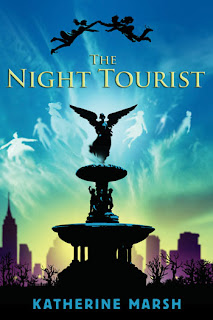
Arty -- The Night Tourist by Katherine Marsh

Jack Perdu is a ninth-grade Classics prodigy, living with his father on the Yale University campus and spending his time translating Ovid's Metamorphoses. He doesn't spend much time with the other kids, preferring to bury his nose in the old Greek legends - especially his favorite, the story of Orpheus and Eurydice.


Then Jack is hit by a car. He should have died, but he pulls through. That's when he starts to see things - odd things. His father sends him to a doctor in New York City, just in case.

That's where Jack meets Euri, a girl his age, who leads him down to the underworld beneath Grand Central Station. But the people that live there aren't quite right - and Jack's about to find out why.

As a Greek mythology fan myself, I found the story especially interesting, though, as a few Amazon reviews have noted, those who aren't familiar with the basics of Greek legend might miss half the fun.

The Night Tourist takes all the best of both legend and ghost story and blends them together. There's the New York Underworld (as opposed to the Greek Underworld), the three-headed guard dog, the 'Now That You're Dead' seminar, the ways the ghosts mix with the mortals... it's all delightfully morbid without being depressing.

Jack was extremely likable, and, surprisingly, Euri was as well; their chemistry felt natural and sweet, without being forced or even romantic - a welcome change from most stories. Few characters were important enough for a great deal of building, but the ones that were - Jack and Euri, mainly - Marsh revealed at a good pace.

That said, Marsh's underemphasized, simplistic style didn't compliment the characters very well. Especially at the beginning, it was almost hard to read with interest. The writing gets better the farther along the story progresses, but there's always the nagging feeling that it could have been better.

The story has a few different subplots, and at times it can be hard to keep them all in mind. The subplot revolving around Jack's 'deceased' mother and his living father gets especially confusing at the tail end of the novel, but the persistent reader will be able to sort it out after a while.

A few more notes for cautious readers: The idea of the afterlife in this novel is a very popular one, with ghosts being stuck in their underworld until all their 'problems' have been solved. Then they 'go on;' wherever that is, we're never told. A few ghosts toy with the living, who are trying to communicate using a Ouija board. Suicide was addressed, briefly, but in an... well, an interesting way that I'm not sure I really agree with.

Despite all that, The Night Tourist really was a good book - the ending, especially. Marsh does not sugarcoat, and she does not give you a happily-ever-after. But there's a certain bittersweet finality that makes you want to read it all over again.

Saturday, July 31, 2010

Arty -- Dread Locks by Neal Shusterman

I have to admit it, I was skeptical when Persy gave me this book to read. It looked like some angsty teen romance with lots of violence and forbidden love. But that's why there's that adage - Don't judge a book by its cover.

Parker Baer is bored of his rich family and their constant un-delayed gratification. They get everything they want, whenever they want. Parker's parents even gave him a statue for his birthday - of himself.

Then Parker finds Tara.

After making herself at home to the Baer house and even trying out Parker's bed, golden-haired, sunglasses-wearing Tara makes herself at home at their whole school. Soon the charismatic stranger has half the school 'wrapped around her little finger.'

When some of the students start developing freakish habits and cravings, Parker knows Tara is to blame. But how? And when Tara starts affecting Parker himself, will even he be able to end her game?

The first book in Shusterman's Dark Fusion series, Dread Locks combines the myth of Medusa and the bedtime story of Goldilocks. Unlikely? Yes. Amazing? Oh yes.

At 176 pages, Dread Locks is short and very, very sweet. There are no subplots, no real character development except for Parker and Tara. You would think this would work against the book, but it doesn't. The continual tension between those two characters is more than enough. The story happens to the other characters; Parker and Tara happen to the story.

The writing is tight, with very few unneeded words and phrases. Dialogue is realistic. The plot is engaging. The ending blows you away with its unexpectedness. A subtle moral that you absorb more than read. There's really not much more to say for Dread Locks - except that any fan of mythology, fairytales, or fiction in general should read this book.

It is a dark, intense, at times horrifying book. You will probably not laugh while reading it. I know I didn't. Readers seeking more light-hearted takes on fairytales and mythology should check out the Sisters Grimm series (fairytale) or the Percy Jackson and the Olympians series (mythology). But if you're not afraid of a good, dark book, then Dread Locks is a must-read.

Sunday, June 27, 2010

Arty -- Ever by Gail Carson Levine


Ah, a good old-fashioned fairytale... or is it?

Kezi is a beautiful young woman, an only child in her average family in the kingdom of Hyte. Typical heroine in a fairytale, yes? Now meet her knight in shining armor: Olus, the Akkan god of wind.

Think Jepthah's Vow in the book of Judges, plus Greek immortal-and-mortal love story, plus elements of Middle-Eastern religion. And you have Ever.

Olus, at seventeen years old, is the youngest Akkan god. He's not comfortable around the other millennia-old deities, so he decides to spend some time with the mortals on earth. He travels to Hyte, where he buys some goats from a farmer and settles down to watch mortality.

There he watches the daughter of the farmer who sold him the goats: Kezi, a fifteen-year-old girl with a talent for weaving and dancing. Olus falls in love with her from afar, and soon he contrives a meeting with her. They (of course) fall in love instantly. But, when her mother falls ill, Kezi's father promises their god Admat that if Admat will spare his wife, he will sacrifice the first person to congratulate him. Kezi's mother recuperates - but, to save the life of her aunt, Kezi bursts out with congratulations to her father. Her death sentence issued, she begs Admat for thirty more days to live.

Olus, naturally, can't bear the thought of Kezi's death. He whisks her away on his winds and tells her he wants her to become immortal. She can still be sacrificed, but she'll live again. Kezi agrees, and they set out to become heroine and champion.

For the most part, I'm a big fan of Levine's work. This idea is a fascinating one, and I was sure she would be able to pull it off. But the story fell flat about a third of the way through. I'm not sure what went wrong, but I think part of the problem was lack of originality. As I mentioned above, most of us have probably heard the story a hundred times from Greek legends. With originality the idea could work, but it doesn't feel like Levine tried too hard.

Another bothersome thing was the characters. Kezi and Olus had very little depth to them. Kezi seemed nice and, in some ways, heroic. But there were times when she came over as petty, or weak, or downright rude. Olus was better (I generally like the male half of a pair more), but I had to question his intelligence at falling in love with a rather mediocre girl like Kezi.

The book is written in present tense, in first-person perspective from both Kezi and Olus. The chapters alternate between Olus and Kezi. This bothers some people, I know, but to me, it was an interesting way to write the book. The style, however, couldn't fix the disappointing ending, which, though certainly not a happily-ever-after ending, felt almost random and much too easy.

It probably sounds like I didn't enjoy Ever. I did. As a fast 'beach' read when I don't want to use too much brainpower. But if you're looking for a more substantial fairytale, I would suggest Levine's The Two Princesses of Bamarre, or Shannon Hale's Bayern series, beginning with The Goose Girl.

Sunday, June 13, 2010

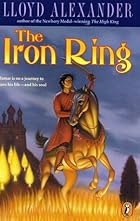
Arty -- The Iron Ring by Lloyd Alexander

In the middle of the night, young king Tamar is awoken by a parade of elephants and courtiers. The cause of the discourteous commotion is King Jaya, a monarch of a faraway kingdom, who is passing through and demands lodging. Jaya promptly challenges Tamar to a game of aksha (a dice game), with increasingly high stakes. Caught up in a rash of winnings, Tamar feverishly bets his life against Jaya's - and loses. Triumphant, Jaya claims his prize... and vanishes. No one but Tamar seems to remember the rude king's visit, and there is no proof for it - except for the iron ring around Tamar's finger, symbolizing, supposedly, Jaya's hold on Tamar's life.

As there is still a chance that Jaya was not a dream, and therefore is still owed a life-debt by Tamar, Tamar decides to journey to Jaya's kingdom. Taking his loyal mentor and brahmana Rajaswami with him, Tamar sets out to make good on his dharma, or honor.

As my first non-Prydain Lloyd novel, I had high-hopes for The Iron Ring. Admittedly, I shouldn't compare, but it is hard to be unbiased with the other books of an author who wrote such a classic series.

Basically, The Iron Ring is a not-so-epic epic. Using something of a formula in fantasy, the protagonist goes on a quest with his trusty mentor, meets both comedic and mysterious sidekicks, and his ladylove, along with, of course, a minor villain. All while the threat that the iron ring symbolizes hangs over Tamar's head.

The first part of the book was amusing at times, tiresome at others. Very little was unexpected. Mirri, especially, I found annoying, as a typical 'I am woman, hear me roar at you bothersome men' heroine. Tamar and the other characters were flat and unappealing.

About three-fourths of the way through the book, however, things picked up. Action was more interesting. Tamar was at rock bottom; this character was dead; is another dead as well? Or is there a plan? These chapters rekindled my dying interesting. But the flames didn't last long, and the end fizzled in what seemed a cop-out.

There was also a definite lack of the title character - the iron ring. In a story one would think was about Tamar's determination to get to the bottom of King Jaya's odd appearance and disappearance, he thinks very little about his bondage. During the first part of the book, little 'mini-adventures' distract him; the second part is filled with fighting the minor villain. One starts to wonder what the goal of the story is, after a while.

On a more positive note, The Iron Ring is based on Indian and Hindu mythology and psychology, with plenty of talking animals (more so than humans) and dharma-defending. At times this was confusing - are they not surprised that animals talk? I thought this character just voiced doubt about the forest's talking beasts. But the information on a mythology rarely studied was interesting, and I can see Lloyd's attraction to it.

In short, The Iron Ring is a typical mini-epic. Short on originality, though full of potential inspiration. Readers fond of Lord of the Rings-esque, questing novels will be interested; to others, I would hesitate to recommend it.

Saturday, May 29, 2010

Arty -- The Red Pyramid by Rick Riordan

After finishing his (dazzling, in my opinion) debut series, Percy Jackson and the Olympians, Rick Riordan is back with another series about mythical deities - only this time, they're Egyptian in origin, not Greek.

Carter and Sadie Kane barely know each other. They were separated six years ago, when their mother died. Carter lives with their dad, Julius Kane, an Egyptologist who moves around a lot. Sadie lives with their mother's parents in London. The siblings only see each other twice a year. They're practically strangers.

But they don't stay strangers for long. This Christmas, on one of their visiting days, Julius takes Carter and Sadie on an outing to a museum. Sadie isn't thrilled at the prospect, but neither siblings are very happy when their dad blows up the Rosetta Stone. It doesn't get any better when a being from the Stone entraps their father and disappears with him.

Carter and Sadie quickly learn their father released five Egyptian gods from the Stone, and that one of them, Set, has banished Julius to oblivion. Suddenly thrust into a world where Egyptian deities and creatures are alive and well, with a father - and the world - to save, Carter and Sadie have to crisscross mortal and immortal boundaries for a way to defeat the evil their father released.

The Red Pyramid is a fascinating, complex, enjoyable book with deep characters and some good 'curve balls.' However, I think Riordan tried a little too hard to mimic the success of Percy Jackson. It's not glaringly obvious, but deep down, many parts seemed contrived. Mysterious dreams, characters acting oddly, plot twists - it all felt like he was trying to recapture the intrigue of the Olympians far too early in the series. As a result, you're so bogged down with loose ends and character backgrounds, you can barely pay attention to the action going on, wondering who has what motives where.

The characters are typically amazing. As usual, I got more into the supporting characters than Carter and Sadie, but the siblings were likable, with Carter's more serious voice and Sadie's snarky tone. The gods, however, were the ones who really shone: Bast, Anubis, and Thoth, along with other deities. The dialogue was witty, though fans of PJO's more obvious humor may be disappointed.

Action is never lacking. When they're awake, Carter and Sadie are fighting, running, or learning; while asleep, their bas, or spirits, are roaming the earth, seeing helpful visions. It's a wonder they could even stay on their feet. While some of the battle scenes aren't exactly realistic - it's hard to imagine a twelve-year-old girl fending off a thousand-year-old magician, no matter what her bloodline - they still get your attention and make you wonder just who's going to win.

There's really not much more to say about The Red Pyramid. It's not fair to compare it with Riordan's previous series. Still, I don't think the Kane Chronicles will be garnering the same amount of attention and acclaim. Perhaps if the next books are better. But for now, the Red Pyramid is merely an entertaining adventure of Egyptian deities, pharaohs, and magic.