Showing posts with label review. Show all posts

Saturday, July 25, 2015

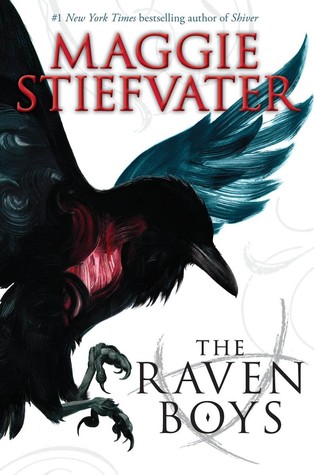
Arty -- The Raven Boys by Maggie Stiefvater

We return after your abnormally scheduled hiatus! The Wednesday Scrolls roundup review will, hopefully, come next Wednesday - just in time for the July review, as well!

Anyway, onto the review.

I read The Raven Boys a little over two years ago, not right after it had come out but not long after, either. At that time, some of my favorite 1- and 2-star reviews were of Stiefvater's Shiver and sequels, so I wasn't happily inclined to it; still, I remember thinking that the beginning was intriguing and the writing wasn't terrible. After two hundred pages or so, though, I'd lost interest.

It took a lot less time to lose interest the second time around.

The basic premise(s) is this: Blue Sargent lives in a purely X-chromosomal household of psychics, including her mother and various aunts/friends. She has no powers herself, but everyone knows her fate: if she kisses her true love, he'll die. Meanwhile, on the opposite side of town (metaphorically speaking), obscenely wealthy 17-year-old Richard Gansey is searching for the lost Welsh king Glendower, while simultaneously holding court at obscenely wealthy Aglionby Academy boarding school. His friends - Sharkteeth Ooh Ha Ha hot-headed Ronan Lynch, the lowborn, timid Johnny Cade Adam Parrish, and the smudgy and otherwise un-nicknamable Noah - help him navigate both real life and the magical realm of ley lines and dreams and... um, magic stuff. Unfortunately, the two worlds are about to collide - because BLUE SEES GANSEY IN A CONTEXT WHICH MAKES IT PRETTY OBVIOUS THAT HE'LL DIE BECAUSE OF HER KISS! AND YET THEY DO NOT STAY AWAY FROM EACH OTHER AT ALL! NOT EVEN A LITTLE BIT!

I will start out with the pluses. Stiefvater has no small control of the English language, technically speaking. She commits very few, if any, rookie gaffes that should have been caught by an unbiased editor. The whole book reeks of Pine Sol for writing - it's that polished. She has a good turn at atmosphere, too, and description that only makes you think she's telling you what to imagine. It's pretty cool, I'll admit that. If you ask me what anyone in this book looks like, I'd be hard-pressed to tell you; still, my brain still knows what it thinks they look like. Weird.

And, credit where credit's due, the whole concept is great! There are ravens and Virginia landscapes, Welsh kings and Latin trees, psychics and ghosts, and what can be technically classified as "banter." About 92% of this book's dialogue is made up of "banter." It's like a whole Avengers: Age of Ultron battle scene, toned down to slice-of-life and stretched out over 400 pages.

The problem is that the book is exactly as tedious as that sounds.

For all the talent she has at building technically pleasant sentences, Stiefvater has no meaning of the word 'subtlety.' Even her subtlety is unsubtle. As rife with opportunity for drama as the book is, every scene is depicted as Very Dramatic. As a result, nothing is dramatic. It's all so one-note and drenched in Gothic Undertones, the whole effect soon dries out. It becomes wearisome. When Stiefvater makes an event out of Gansey talking about his hornet allergy, I stopped caring. The drama had no place to go because she'd already hit the drama ceiling.

As exhausting as the constant drama was, Stiefvater's floral and self-conscious style is even more draining. It's the kind of style that feels pleased with itself, and how beautifully it uses words. We all know the old adage, thrown at as as soon as we picked up a pencil: "Show, don't tell." The only thing that Stiefvater shows is that she likes to tell. A line of dialogue might come after a paragraph or two of pretentious, self-absorbed navel-gazing by any one of the novel's four POV characters.

Speaking of characters! Stiefvater loves her characters. Which is good. Always love your characters, if you're writing fiction. But along with loving one's characters, a writer has to give the reader a reason to love those characters, too. This ties in with the show-don't-tell thing, too, because Stiefvater tells us about her children constantly. It often goes hand-in-hand with the aforementioned navel-gazing, too, which makes the telling even more grating. I don't want to know what the author is saying about this character's thoughts about themselves or about someone else! I just want to know what the character is thinking! If I had to hear one more sentence about Blue's "strangeness," when all that showed of this eccentricity was that she embroidered Goodwill boots and didn't obey her mother, I would have screamed. I did roll my eyes a lot. The relationships between Blue and the "raven boys" happened in the blank space between Chapter X and Chapter Y; Stiefvater informs the reader that Blue/Boys are friends and bypasses any pesky relationship growth that might get in the way.

The Raven Boys is increasingly popular, and I can see why. The writing style is ornate and dripping with prosody and metaphor. There are hot boys in all flavors. It appeals to the crowd that likes labeling themselves "quirky" and "old soul" while thinking about how they're not like the others in their demographic - as well as other, more sane crowds, but most noticeably that one. (Hey, I'm still a big fan of the Inheritance Saga - I can't throw too much shade at tastes.) And, like I said, the concept is so good! Not to mention that cover art. Dang. The covert art is why I initially picked it up, despite having Stiefvater's name on it.

Unfortunately, The Raven Boys does not live up to the hype. It's a solid-enough premise that suffers from theauthorloveshearingherownwriting-itis. It's a sophomoric attempt at writing an upperclassman idea. Which is sad. Maybe after Stiefvater graduates with some sort of concentration in "finding your chill," her execution will be better.

Thursday, June 18, 2015

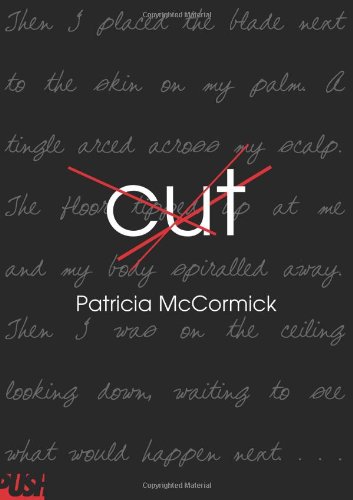
Persy -- Cut by Patricia McCormick

Callie is in a residential treatment facility for young women called Sea Pines. Except they all just call it Sick Minds. Most of her fellow patients are there for eating disorders or drug addictions. But none of them know why Callie is there. Callie doesn't speak. Not to the other patients, not to the doctors, not to the nurses. These days, even when she tries to speak, she can't make anything come out.

But then one day there's a new patient: Amanda. Amanda cuts herself and is unashamed. She doesn't hide the scars -- she flaunts them. Not like Callie, who hides in her long sleeves and her silence.

In the outside world, Callie's little brother has terrible asthma and her mother worries about everything. Her dad's job doesn't go so well anymore. A lot of responsibility fell on Callie every day -- but not anymore. Now she's just at Sick Minds. To get better, to get treated. So much led up to her entry into Sick Minds -- but will she ever be able to speak?

Some reviewers have said that the characters are stereotypical and flat. This is true. But that doesn't mean they're not realistic as well. Take it from someone who knows.

You also have to keep in mind that this book is only 150 pages long. It's not going on an indepth psychological journey of each and every character. It's more of a statement. A statement about an issue that doesn't really get spoken about a lot. The book itself mentions that people with problems such as eating disorders or substance abuse are relatively "normal", but cutters and self abusers... those are just freaks. For an issue so big, it's remarkably ignored.

Anyway, back to the book. I finished it in one sitting, and not just because it's so short. I really got pulled in right off the bat. For starters, it's written a little like a letter. It's all addressed to Callie's psychiatrist, which is a really cool and effective way to do it.

Also, it's incredibly realistic for only 150 pages. Admittedly, I'm a bit biased. Serious talk here, please forgive me, but I have literally been in Callie's shoes. I've spent time in residential treatment for the exact same reason, and reading Callie's story was practically a walk down memory lane. I don't know how it reads to someone without my experience, but perhaps the guarantee that it IS realistic will change the way you read it.

It's honestly not as horrifying as I was expecting. There is a deep dark secret, but it wasn't as deep and dark as I thought it would be. But that doesn't really take away from what's there.

All in all it's a short little book about a big issue, and you certainly won't waste any time giving it a read. I would DEFINITELY love to know what people who haven't spent time in a loony bin think of this little book, because it has to change your perspective. Y'know, just a little.

--Persy

You might like this if you: like short little books; like books about mental disorders; like books that address big issues; want to know more about cutting and cutters; or if you are or know someone who cuts

PS. DON'T FORGET ABOUT RYFBM!! Only a few more weeks!

Tuesday, June 16, 2015

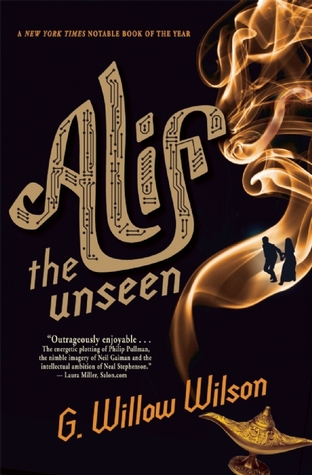
Arty -- Alif the Unseen by G. Willow Wilson

You know the Moonlit Library is back when our reviews are three days late! It's good to renew old traditions. Anyway, on to the review.

I'm here to tell you, not about a book, but about a story. Alif the Unseen typifies what a good story should be - it's the kind of story that you can imagine being told around a fire. Granted, that's a vague piece of criteria for a "good story," but I'd like to convince you with more evidence.

Amazon's summary goes something like this: "In an unnamed Middle Eastern security state, a young Arab-Indian hacker shields his clients - dissidents, outlaws, Islamists, and other watched groups - from surveillance and tries to stay out of trouble. He goes by Alif - the first letter of the Arabic alphabet, and a convenient handle to hide behind. The aristocratic woman Alif loves has jilted him for a prince chosen by her parents, and his computer has just been breached by the state's electronic security force, putting his clients and his own neck on the line. Then it turns out his lover's new fiancé is the 'Hand of God,' as they call the head of state security, and his henchman come after Alif, driving him underground. When Alif discovers The Thousand and One Days, the secret book of the jinn, which both he and the Hand suspect may unleash a new level of information technology, the stakes are raised and Alif must struggle for life or death, aided by forces seen and unseen."

Sounds pretty simple, right? WRONG. Alif is filled with twists and turns, characters good and bad and in between. It's filled with beautiful musings on technology and religion and myth and story and the interplay of them all. It contains awe-inspiring descriptions of the Middle Eastern setting and of the supernatural elements that drag you right into the story. It's also very often pretty hilarious. But don't get me wrong - Wilson is never didactic with any of these topics. The characters are the perfect vehicles for the themes and topics that come up in this story.

Alif is a fantastic non-hero. He's a pretty typical basement-dwelling computer geek, except that he's really, really good at what he does. He's something of a technological prodigy, and yet he's also a really normal dude. His problems start because he goes gung-ho with a blocking program after he's dumped by his girlfriend. He's fifty shades of pathetic, and that makes him flawed, understandable, and endearing, all at the same time. Both his strengths and his flaws are a huge influence on how he reacts to the story going on around him. Wilson handles the humanity of her main character flawlessly.

The supporting characters are so good, too! Wow! Alif's childhood friend, Dina, shines as a sort of "primary side char," who never acts or speaks as if her only purpose in the novel is to be Alif's moral center (though she does sometimes fill that role). She's a well-rounded character with her own life and motivations, strengths and weaknesses. Likewise, Vikram, the first jinn that Alif meets, is a wonderful example of how to write an inhuman character. He's snarky, insensitive to humans' needs, and not always exactly moral as Alif would prefer. But he's real, as real as any of the other characters. The other, lesser side chars - the American convert, Alif's hacker friend, the Sheikh, the other jinn - not to mention the villainous characters, are just as well-drawn, just as real. In short, the characters never felt like characters who existed only as soon as they came on the page; they felt like they had always existed, and the story was just a part of their very real lives.

Like I mentioned, there's a lot of musings on religion and faith, and on art and technology. They're organically drawn into the plot of the story, which is, after all, based on computer technology and Arabic literature (mainly The Thousand and One Nights and the Quran). Not only are they not shoehorned in like sermons or platitudes, they're required by the story. It's a story that needs an intelligent, sensitive handling of faith and art, and Wilson delivers. Does she deliver.

All that rambling about pros (and nothing about cons) to say, read this book. Wilson writes beautifully about beautiful topics and beautiful characters. It's a must-read for anyone who likes good books. Period.

Friday, June 5, 2015

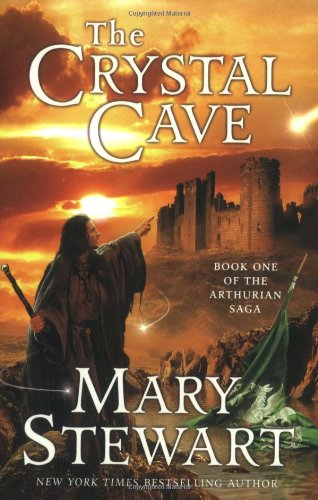
Persy -- The Crystal Cave by Mary Stewart

King Arthur and Merlin and all those chaps have been a part of legend ever since they actually existed, and it's practically a genre unto itself. Sometimes it focuses on Merlin, sometimes Arthur, sometimes Lancelot, sometimes Guinevere, sometimes someone completely random. But the Arthurian legends are still going strong today.

Sorry, we're studying Anglo-Norman literature in my English class right now, so I'm trying not to slip into essay mode. Focus.

Myrddin Emrys is the bastard son of Lady Niniane, daughter of the king of Britain in Maridunum. No one knows who his father is, for Niniane refuses to tell a single soul, even her father the king. It is widely believed that little Merlin (affectionately called so by his mother and others) is the son of the demon or the devil himself, for sometimes he knows things he shouldn't and has a tendency to overhear a great many things.

One day Merlin finds himself in a cave and encounters a wise old man named Galapas, who teaches Merlin many things. Not long after this, Merlin is forced to flee the castle and ends up crossing the sea to Cornwall and in the service of Ambrosius, outcast prince. With Merlin's often supernatural assistance, Ambrosius and his brother Uther just might be able to retake all of Britain and drive the hated Saxons out.

Okay, so that summary is a bit crap, but I'm not super good at all of the Saxons war Britain king stuff. I followed along fine while I was reading, but it's not exactly what stuck with me.

What did stick was all of Merlin's adventures and powers. I really like how Mary Stewart writes him, starting with his toddler years and gradually following him as he grows up. He's not an amazing sorcerer, but no one will believe him when he tells them. He actually is just very very intelligent and likes to learn about everything. True, he's prone to a few destinies and visions every now and again... but really, he's not a magician.

Normally I don't read a lot of epic fantasy or even Arthurian tales in general -- it's just never been my forté. Arty's usually the one who reads that stuff. So I entered The Crystal Cave without much excitement. But I actually really enjoyed the whole adventure. It's definitely an epic in the sense that it moves along slowly at its own pace, unhurried and in no rush to get to the action. There's a lot of description of the war and the tactics of Ambrosius, which makes sense because it concerns Merlin quite a lot. Mary Stewart has some very nice writing suited to the genre she's chosen, though if you like fast-paced fantasy adventure then this isn't the book for you.

What really kept me reading was Merlin himself. His personality is just great. He's very no-nonsense, a bit brash, but also extremely level-headed as he matures into a young man. He knows how to use his brains and his luck, and is extremely good at coming up with something in the moment. No one else likes him much, but in the age he lived in, he wasn't exactly the popular type. Personally, I'd love to hang out with him.

If you like historical epic fantasy and/or Arthurian legends, this is definitely the book for you. There are few more books in Mary Stewart's Arthurian Saga, and I look forward to reading those at some point. They just take a long time to get through because they're each over 500 pages. Not exactly light reading.

It feels great to be reviewing books again. Let's hope it lasts!

--Persy

You might like this if you: like historical epic fantasy; like Arthurian legends; like Arthurian retellings; like Merlin; like magic that's not actually magic but everyone insists is magic; like historical battle fantasy stuff; or if you sometimes have weird visions that cause all your friends to make the sign against evil and make everyone think your absent father is the devil.

Monday, June 2, 2014

Persy -- Starlighter by Bryan Davis

What's this?? A REVIEW??? Did anyone else know those ever happened here? Seriously, it's been like, two or three months. Sorry about that. My bad.

Jason's a young man living on the human world where few people still believe the stories of dragons and human slaves. But his brother is one of those few, determined to save the people who, a century ago, were captured by dragons and taken to another world as slaves. Jason himself isn't sure he believes the stories, but when his brother disappears in search of the lost ones, the quest is left up to him. But first he must rescue Elyssa from the dungeons and accept her strange, perceptive abilities...

Meanwhile, Koren lives as a dragon slave, prized for her red hair and green eyes and bewitching storytelling abilities. But what do the dragons really have in store for her? And is it true that they were enslaved against the will as the humans say, or did the dragons really rescue them from an even worse fate?

It's not a bad fantasy adventure. It's a relatively fast read, so it doesn't feel like you've wasted your life away reading it or anything. Honestly, it's just not good enough to spend a ton of time on. Aside from Arxad the dragon, all of the characters are very one-dimensional and flat. Don't get me wrong, plenty of them are likeable. I honestly love Randall and Tibalt, but they're still pretty flat, plus they're only secondary characters. Jason and Koren certainly aren't bad for main characters, in fact they're pretty cool themselves. And Elyssa's not awful or anything. But... they're all just pretty boring. The character interactions as well are just kind of... flat. 

The plot doesn't really make up for it, unfortunately. Lots of the adventure seemed pretty pointless, making the whole thing unnecessarily complicated. The whole mess with them falling down the bottomless pit and floating down the river and everything totally went over my head and I had no idea why any of it was happening. And then Elyssa's always coming up with "brilliant" schemes that seem totally pointless, like sending Jason out to die while she works on stopping the flood. Why didn't she just try to stop the flood first and then send out Jason? She's supposed to be super smart, but she just strikes me as kind of distracted.

If I were to sum up this book in two words, they would be "needlessly complicated." I think if it had been edited down a bit more it would've been really something, but as is it kind of reads like an early draft I wrote when I was twelve. Tons of twists and turns and delays and puzzles and not much else.

I will say that the Black Egg gives me genuine creeps. That part was extremely well done. When he's trying to convince Koren, I actually wasn't sure for a minute if the Black Egg was good or bad. And the fact that I was so unsure and on edge made it so much more interesting. It's honestly one of the few reasons I'm looking forward to finishing the book series.

--Persy

You might like this if you: like dragons; like Christian fantasy; like simple fantasy adventures; don't care about the characters; have time to kill; or if your ancestors were kidnapped by dragons.

Monday, March 24, 2014

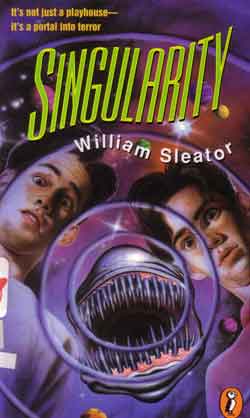
Persy -- Singularity by William Sleator

Sooo I really was going to write this on an actual weekend day, buuuuut my dorm kind of flooded last night and it threw off my schedule just a tad. I'm also super sleep deprived and loopy right now, so this is going to be an awesome review! Yay college!

Harry and Barry are sixteen-year-old twins. Harry is smart, Barry is athletic and popular and generally gets what he wants. Their family randomly inherits the old house of a crazy uncle, and Barry gets it into his head to spend a few weeks there while their parents are away. Harry thinks it's a bad idea, but Barry convinces their parents.

There they meet Lucy, a teenage girl, and hear stories of animals wandering onto the property and then disappearing. When the trio unlock the playhouse, they slowly discover that inside time passes differently. Once you step inside, the outside world practically stands still. You could spend a year in there and mere hours would pass outside.

There is a singularity inside the playhouse, a portal to another world that is affecting time. Harry finds their uncle's journal and begins to get worried about what might come through the singularity. He wants to tell someone, but Barry threatens to lock himself inside the playhouse if Harry does anything.

This is a really lame summary. Sorry, I'm really just out of it.

Basically, the point is that there's a singularity and Harry is super awesome. And there's a dog, Fred, who's cute. And there's a singularity. And it's awesome.

But really though, I love this book. There's a very eighties feel to the writing and yeah, it starts off pretty slow in the beginning, but it definitely pays off. I mean, talk about character growth (this should make you laugh if you've already read the book).

Yes, I would've liked even more time travel play and that kind of thing, but this isn't meant to be an indepth, hard scifi novel. It's basically a quick, young adult read, and it functions very well as such. Because it's not super hardcore, readers who don't normally like scifi can probably still enjoy it, while there's still enough awesomeness for scifi nerds to get into. It's a very nice balance.

So, y'know. Read it.

--Persy

You might like this if you: like time travel; like science fiction; like hard science fiction but want a quick read; only like soft science fiction; aren't normally a huge fan of science fiction; like character growth; like awesome books; or if you feel like time passes super slowly sometimes and are worried about the possible causes.

Monday, February 10, 2014

Arty -- My Most Excellent Year by Steve Kluger

Look who's finally getting around to appearing again! Sorry, I had an influx of homework and suddenly all I was reading was stuff that you can't really review on a "fluffy stuff you read to feel good" sort of review blog. Also, look for the review of January this Wednesday, because I am slime who can't keep a deadline.

Anyway! Let's talk about happy things, such as books that make me laugh out loud. My Most Excellent Year is one such book.

In it, we have Anthony Keller, aka Tony C, aka T.C., aka Tick, a crusader for baseball rights and the love of the new girl in town; Augie Hwong, obsessed with and knowledgable about all things related to classic movies and musicals; Alejandra Perez, the above-mentioned new girl in town who also happens to be the daughter of a UN ambassador, a crusader for social justice, and a closet singer/dancer. Throw in a small deaf child named Hucky with a serious addiction to Mary Poppins, budding romance between kids and adults alike, and enough baseball and cinema references to choke a Wookie, and you have My Most Excellent Year.

Firstly, the writing is excellent. Like John Green, there tends to be one overall tone for the characters, without much deviation in terms of character voice; unlike John Green (I'm so sorry), Kluger manages to pull it off. Maybe it's because the subject matter is more lighthearted than JG tends to go for. Anyway, with such smooth, natural writing, it's kind of a given that it'll succeed at the emotional/comedic points it attempts. And it does, for the most part (no novel is perfect).

The characters were, on the whole, loads of fun. T.C. starts out as a pretty flat, cliché character, but by the time the novel ended, he'd uncovered his secret stash of complexity and emotion and won my heart, succeeding where most characters like him don't (his mother is dead, he's chasing after a girl who doesn't like him, et cetera et cetera). Alé, on the other hand, never really got much affection from me. Maybe it's because I know/have experienced people like her in real life and it's never been fun (people who can make a social issue out of a tissue box). She got more bearable towards the end, and she did have her moments of fun, but overall, she was probably my least favorite character (along with Wei, Augie's mom, who had the same problem).

The characters who really stole the show, though, were Augie and Hucky. Augie, unlike T.C., spouted off trivia I could appreciate - old classic movie trivia. Some of his references I got ("The Cub Room. Where the elite meet.") and some of them reminded me of movies I have to watch soon. His whole thing (all of the characters in this book have a thing) was practically perfect in every way; he managed to be obsessive and a little neurotic without being overbearing, and, indeed, typically being adorable. I would have appreciated more substance in his relationship with Andy, and after a certain point I didn't want them to end up together as much as I had before, but the whole relationship was handled in a sensitive and yet hilarious way, so I don't have much to complain about.

(And I can't say anything about Augie without saying something about his All About Eve addiction. Just wait until you get to the part where he retells the Tooth Fairy story. If he were straight, I would have married him on the spot.)

There's also Hucky, the six-year-old child living in a home for deaf children. I was skeptical of Hucky at first - little kids with disabilities usually end up getting used as emotional props - but he was actually a really adorable character. He's testy, obsessed with Mary Poppins (how many times can I use the word 'obsessed' in one review?), and he helps T.C. cheat at informal baseball games. What more can you say?

The story is rambling, in a good way. There's no real point to the plot, though there are some longterm goals set by the story. And in the end, they're all met. There's a beautiful sense of closure that a lot of 'genreless' novels like these don't have. And that makes a huge difference. Putting down a book with a smile on your face - priceless.

So if you're in the mood for some fun, light-hearted rambles through Boston with a handful of quirky ninth-graders (and a six-year-old with an attitude) (and some hilarious and extraordinarily human parents) (and an older brother who will surprise you) (and a dog named Nehi) (and a lot of references to All About Eve), then I'd definitely recommend My Most Excellent Year.

Saturday, February 1, 2014

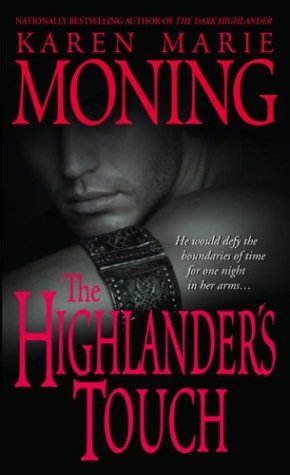
Persy -- The Highlander's Touch by Karen Marie Moning

Here's the thing, Karen Marie Moning: you write a story in which time travel plays a significant part, and I'm GONNA be harsh.

This is actually the third book in Karen Marie Moning's historical romance Highlander series, but you don't have to read them in order, so don't worry about spoilers for other books. However, if you don't know the standard plot to a romance novel and/or don't mind discovering one or two minor plot surprises, you might not want to read this review.

Lisa Stone is working two jobs, struggling to support her cancer-ridden mother. Her father died long ago, and now she's all Catherine, her mother, has. She works as a night maid for a museum, and one night she happens upon a mysterious artifact and... well, touches it. She is instantly transported back in time to the Scottish highlands... where she comes face to face with Circenn Brodie, a deadly man who is a stickler for rules. But will his unquenchable love for Lisa cause him to break . . . every . . . single . . . rule?

Sorry, I get super dramatic when I review romance novels. Dunno why.

Let's start way back in the Prologue. Circenn curses a flask so that once it is touched it will be transported back to him, effectively returning the lost flask. Unfortunately, it will also return whoever touches the flask. Adam gets pissy and makes Circen swear to kill the bearer of the flask to protect all the secrets, or whatever. After a lot of arguing, Circenn makes the oath. But here's the thing: Circenn swears to kill the MAN who touches the flask. MAN. MALE. Guess who brings the flask? Right. A woman. I totally expected this to be the loophole. And it would've worked SO WELL because Adam knew who would pick up the flask, and Adam didn't actually want her dead, and even if Circenn forgot he said man, Adam could've been all, "Remember, you swore to kill the MAN. AHAHHAHAHAHAHAHHAHA."

But that's not what happened. Oh well.

Moving on. I don't see what the big deal is about Circenn being immortal. I mean, yeah, I get not wanting to curse anyone else with immortality, but still. Do you have any idea how much trouble would've been saved by him just spilling the beans? "Oh, Lisa, your mother is going to die alone in the future? WAIT, I'm IMMORTAL. I promise to seek her out and take care of her. Heck, I'll even throw my sexy bod into the equation."

But that solution never occurred to anyone. Whatever.

Moving on. Perhaps this is a small detail, but it seriously bugs me. The longer Lisa spends in the past, the more upset she gets because every day she spends there is a day her mother is alone. But... she's not on another planet. She's in the past. So if she were to find some sort of way to time travel... she could just travel back to the moment she left.

But maybe I'm just being nitpicky about time travel.

But now that we're on the subject, the ending. Oh. my. gosh. the. ending. Romance novels are notorious for magical, happily ever afters, but THIS? SERIOUSLY? You are taking it TOO FAR, here! You can't just DO THAT.

There are also some absolutely random parts that I don't understand. There's the stereotypical best friend Ruby, who gets left behind in the modern day world. She has a total of two scenes, and afterwards she's sometimes referenced but never more than to explain away bits of knowledge or clothing that Lisa possesses. There is never any sign that Lisa misses her best friend. But this isn't a major issue.

What strikes me as REALLY odd is the redhead who snubs Duncan. I mean, what the crap? She and her brother hint at some malicious intent and there's the insinuation that they're even lying about their names. Moning goes into such detail about her appearance and the scene seems so dadgummed important... and then she disappears completely. Maybe it's a reference to another book in the series? I don't know. But it's just plain weird.

And my final irritation... the first time Circenn sees her in her undies, she says that he caught her in the one fancy pair of underpants she happens to own: a set of lacy lavender lingerie. The ONE pair she owns. But then at the very end, she rushes to get dressed and we find out later that she is now wearing a set of lacy PINK lingerie. What.

Oh wait. Of course. Of COURSE she'd have more lacy lingerie, because THEY CHANGED THE EFFING FUTURE. Naturally, that would result in her having more pairs of flirty underpants.

All that aside... I mean, the characters weren't bad. I guess. I didn't think the book was too awful until I started writing a review of it. Let's be honest, this isn't much of a review... more like a rant. But I can't think of anything so awe-inspiringly brilliant that it would make up for all of my little pet peeves that showed up in the book. I swear, when I was actually reading it, it wasn't awful.

But she messed with time travel. How can you expect me to not be harsh?

--Persy

You might like this if you: just really like historical romances; like time travel, but don't like it when it's complicated; have an afternoon to kill and don't want anything serious; or if you work as a night maid in a museum and wonder what would happen if you inspected all the artifacts yourself. That's right, bad stuff would happen. Don't do it.

Sunday, November 10, 2013

Persy -- How To Make Friends and Monsters by Howard Boward (with a little help from Ron Bates)

Howard Boward is a super genius, but super intelligence doesn't make you a lot of friends in middle school. The UPs (uber-populars) only notice him when they find him in the way or when he runs down the school halls in a unitard, and then they call him How-Weird.

His mom, disturbed Howard's friendlessness, gives him a book: How to Make Friends. At first Howard refuses to read it, but gives in out of curiosity. The book gives him a brilliant idea on how to make a friend.

After gathering equipment and an unwanted lab assistant, Howard builds himself a secret laboratory in his basement and sets to work. A few accidents later and he has his first friend (and monster) on his hands. He names his new friend Franklin Stein and takes him to school...

Franklin is almost instantly a hit with everyone, including the UPs. And it's not long before Howard soaks up the spotlight as well... But Franklin's secret origins won't stay hidden forever, and what happens when Howard no longer needs him?

This book is a delight in every way.

When I first got the book in the mail, I was lovestruck. "Perfect size! Perfect shape! Perfect color! Perfect cover! Perfect cover material!" For a while I was almost afraid to read it for fear that it would be awful and then the perfection of the physicality of the book would be such a waste.

But I was not disappointed.

Howard Boward is a brilliant little nerd with a streak of passive sarcasm, and he's probably one of my favorite main characters of all time. And Franklin... Franklin, Franklin, Franklin. He's the BEST. Oh my gosh he's just so freakin' (franklin?) adorable. I just want to hug him so super duper hard and then I want to smack Howard for being mean to him sometimes. But then not really, because I really love Howard too. Yeah.

Reynolds and Winnie are also superb supporting characters, not to mention the rest of Howard's family. How often do ALL of the supporting characters turn out perfectly? Very, very, very, very, very rarely. All of the characters are simply amazing and they make it an absolute joy to read.

If anyone dares to say that the plot is too crazy and farfetched I might have to punch them in the face, because that is hardly a big issue in this book. I think the plot is perfect. It's one of those great books with character development that isn't too inspirational and meaningful and painstaking, if you know what I mean. Howard goes through a lot and learns a lot of lessons and really does change for the better.

Plus, the illustrations are franklin adorable. Props to André Jolicoeur (um, his last name in French means "pretty heart." That might be the best thing EVER).

How To Make Friends and Monsters is such a perfect, delightful little book. The orange is so cheerful, the cover illustration so intriguing, the size so perfect, the material so comfortable in your hands. And then you open it up and don't put it down for a few hours until you're done, and you walk on sunshine for the rest of the day.

Ron Bates hasn't "helped" anyone else write anything yet, but I'll definitely be keeping an out. He's kind of hard to find too, but you can visit his website here. Though I recommend you read the book before watching the promotional video...

--Persy

You might like this if you: love perfectly sized books; love perfect covers with perfect insides; love adorable illustrations; want a cute, short read; like awesome things; like The One and Only Ivan by Katherine Applegate; or if you have a hard time making friends yourself.

Saturday, August 17, 2013

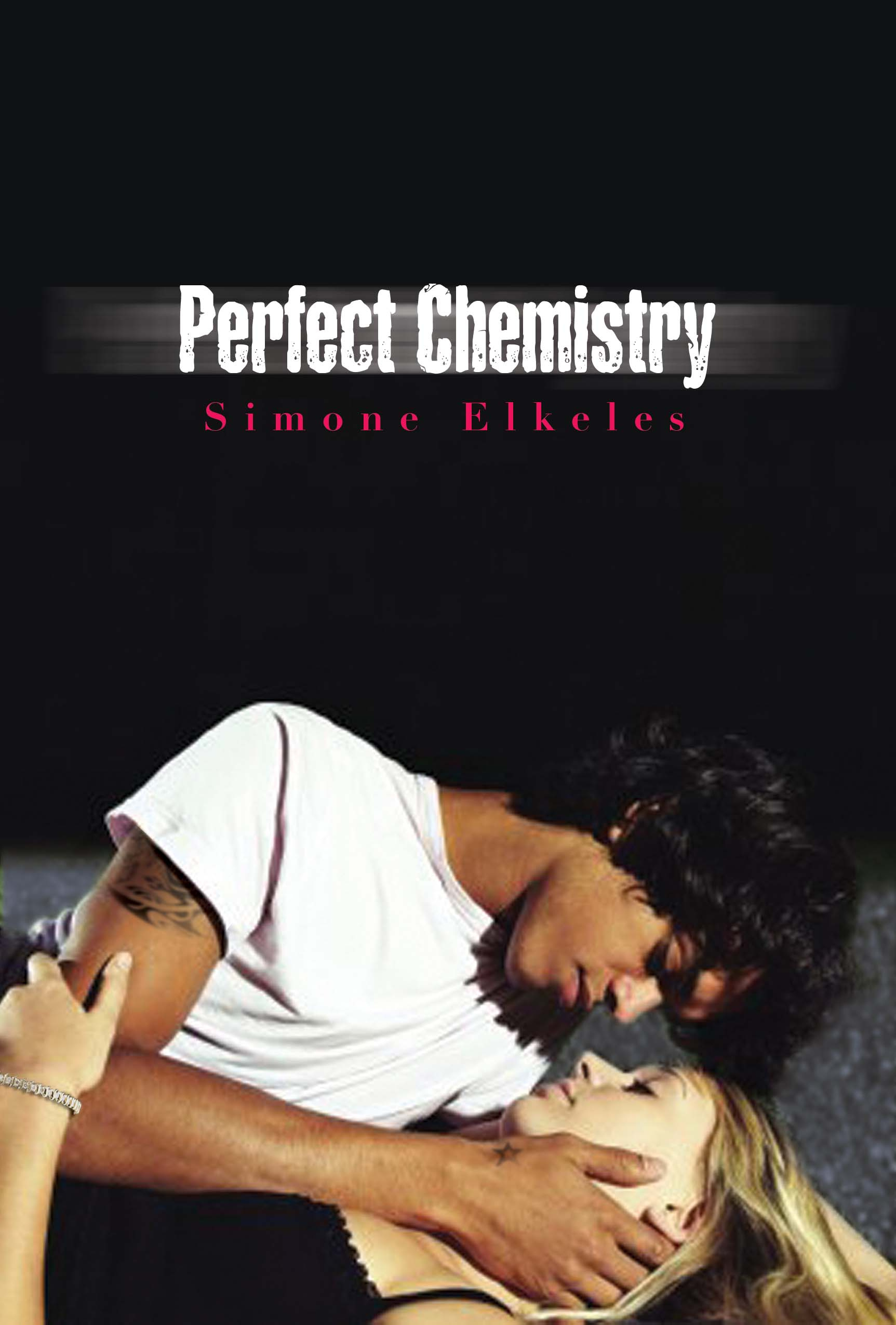
Persy -- Perfect Chemistry by Simone Elkeles

Y'all should be proud. Because even though I just spent my first night in a college dormroom and I've been way too busy the past few weeks to read a reviewable novel... I'm bringing you an ontime review. Shazam.
 
All Brittany wants to do her senior year is maintain the perfect life others see: the clothes, the grades, the cheerleader, the boyfriend. What they don't know is that Brittany struggles to take care of her autistic sister and deal with her distant parents.
 
But her first day goes ominously bad. She accidentally amost runs over Alex Fuentes, the toughest guy in school, and then finds out she has to be his partner in chemistry. Yikes.
 
Meanwhile, Alex is just trying to take care of his brothers and his mom and protect them from the gangs by being in one of the gangs. But when a bet is placed over Brittany's virginity, his world gets a little more complicated...
 
I was expecting to either hate the book and quit within the first five chapters or find a surprising new favorite. I did neither.

My first impression was that Simone Elkeles is trying pretty hard, and almost has really good writing. Instead, it's just pretty good. The best thing this book has going for it is that it's real easy to read quickly, so the 350 pages goes by in a breeze. If it didn't, I'm pretty sure I wouldn't have finished the novel.

I'm not sure if this is supposed to be a retelling of Romeo and Juliet or not, but it basically is. So I might consider excusing the stupidity and hopelessness of Brittany, the heroine. She's kinda... boring and... silly and... impetuous, in a weird kind of way. I'm honestly not sure what her personality is supposed to be. Alex is a little better, but he's also very dramatic and I can't see why he's so in love with Brittany.
 
I personally like Alex and Shelley, but whatever.
 
And then Mrs. Peterson is really cool. In fact, she's probably my favorite character. But whatever.
 
Y'know what's really silly? The epilogue. I mean, I guess it's kind of cute in a weird kind of way, but it's also just... silly. Sorry.
 
Overall it's not a bad book, but I certainly wouldn't reread it and I don't think I'm even going to continue the series (the second book is about Alex's little brother and the love he finds in an unexpected place!).
 
--Persy
 
You might like this if you: like shallow romance; like Romeo and Juliet; like high school romance; like forbidden romance; or if you yourself are shallow, in high school, and are involved in a forbidden romance.


Monday, August 12, 2013

Arty -- The Selection by Kiera Cass

Friends, readers, countrymen - I bring you a YA dystopian romance that doesn't completely suck.

I know, I know, le gasp.  This is not to say "GO OUT AND BUY THE SELECTION RIGHT NOW CUZ AWESOME!!!1!!" YMMV and I recommend a library read before committing.

But seriously guys.  AMERICA.  AND MAXON.  AND MARLEE.  THESE CHARACTERS.

Have a Goodreads summary:

For thirty-five girls, the Selection is the chance of a lifetime.  The opportunity to escape the life laid out for them since birth.  To be swept up in a world of glittering gowns and priceless jewels.  To live in a palace and compete for the heart of gorgeous Prince Maxon.

But for America Singer, being Selected is a nightmare.  It means turning her back on her secret love with Aspen, who is a caste below her.  Leaving her home to enter a fierce competition for a crown she doesn't want.  Living in a palace that is constantly threatened by violent rebel attacks.

Then America meets Prince Maxon.  Gradually, she starts to question all the plans she's made for herself - and realizes that the life she's always dreamed of may not compare to a future she never imagined.

I don't actually know what's up with that last paragraph, because... there's nothing much like that in the book at all.  Maybe it's a series overview, I dunno.  But it makes America sound all dramatic when she's such a down-to-earth kind of person.

America is what made the book for me, mostly.  She has her Weepy Sensitive Heroine moments, and she can jump to some pretty drastic conclusions without a lot of evidence, but for the most part, she's a really friendly girl.  Her character is pretty consistent, and along with lovely consistency is likeableness.  It's really pretty dang fantastic.  The only thing that annoyed me was the constant "Oh boohoo I'm not pretty" when basically everyone else told her she was - why that needs to be a thing, I have no idea.

Also, MAXON.  Maxon is a sweetheart.  I don't think Cass was really comfortable writing him at first - he came on kind of stiff, and not just the kind of stiff she was going for - but as it went on, he became a teddy bear.  Impulsive and naive, but a teddy bear.  And, before the inevitable Love Triangle of Wangst broke in, he and America had the most. adorable. friendship.  YOU MEAN BOYS CAN BE FRIENDS WITH GIRLS WITHOUT THERE BEING ROMANTIC INTEREST AT FIRST SIGHT?

(We don't talk about Aspen.  Aspen is a testosterone-fueled child who needs to grow up a few years before getting into a serious romantic relationship.  Go away, Aspen, no one likes you.)

Plotwise, the Selection competition - thirty-five girls being gradually whittled away until Maxon chooses his bride - isn't as fierce as the blurb makes it out to be.  Only a few of the girls turn out to be conniving witches; it's even mentioned, a couple times at least, that the majority of the girls are close and don't want to intentionally sabotage the others' chances.  I liked that, since most YA likes to depict large crowds of girls evil queen bees with a few honored exceptions (aka, the protag and her one/two friends).  Maybe it made the plot less intense, but it was unexpected and there wasn't an overload of the author trying to come up with a load of different ways to tell us "MOST OF THESE GIRLS ARE EVIL."

The rebellion groups - nice, realistic touch, there being more than one rebellion group - weren't very intimidating except for one scene, mostly because the worldbuilding in The Selection is the very weakest part of this book. (It tends to be, I've noticed, in most new YA dystopian romance.)  There is the mystery of one group (I can't remember whether it was the Southern or the Northern group) trying to get inside the castle to steal something, but it was hardly a major plot point.

I can't talk about this book without going into massive hysteria about the last chapter, which should be entitled "In Which America does what Every Female in the Typical YA Love Triangle should Do but usually Doesn't."  No spoilers other than that, but it just made me really, really happy and put me firmly in the court of Team America.

Weak and cheesy writing - on an infrequent but consistent basis.  Not really that much conflict - yes.  Almost total lack of worldbuilding - yeah.  However, The Selection has a great MC, a great prince/friend/love interest, and genuine hope for an even more awesome sequel.  Definitely a recommend!

Sunday, July 7, 2013

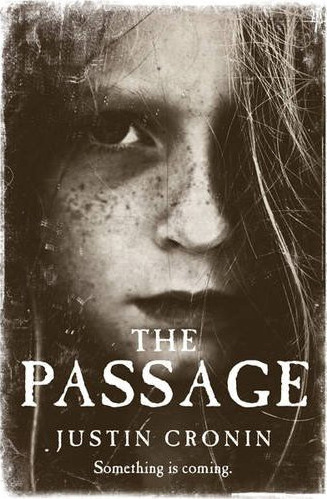
Persy -- The Passage by Justin Cronin

Are you ready for my round of excuses? Well, I was out of the country for almost a month, and then I got the chickenpox...
 
Science is cruising along, forever searching for the equivalent of the fountain of youth. Someone thinks they've found it... but is it what they think it is? Meanwhile, a young girl named Amy is abandoned to a group of nuns, and then kidnapped by the government. She becomes part of the experiments and while the world falls to ruins around her, she remains... Amy. And something a little bit more.
 
Almost a hundred years later, the story takes up with the small community of survivors who live inside a walled city with electric lights that will eventually shut off for good. And once that happens, no one will be able to stop the "smokes" from getting in and killing everyone.
 
The smokes are what happened when they tried spreading their fountain of youth. They got youth all right, but also a lot more. Superhuman abilities and a dose of insanity, and insatiable thirst and hunger for blood...
 
The little community's fragile peace is disturbed when Peter Jaxon runs into a Walker outside of the wall, a young girl who cannot speak with her mouth but somehow communicates exactly what she needs to say. No one knows where she came from, but it doesn't take Michael long to find the chip in her neck, put their years ago by the military. And it doesn't take him much longer to find a signal being sent out for her, asking for her return.
 
As the little community crumbles and the infected breach the walls, Peter leaves with a small crew to find the source of the signal, and, just maybe, other survivors.
 
This book took me over four months to read. That is a freaking long time. Geez. Admittedly, part of the problem was just crazy life stuff, but still. I mean, thinking about all the other things that have happened in the last four months, it's ridiculous to think that I've been reading the same book the whole freaking time.
 
Anyway. All that said, it makes it rather remarkable that I didn't just give up on the stupid thing. For some reason, I just kept on reading, kept re-checking it out at the library.
 
The beginning really drew me in, but the sudden drastic setting change really disoriented me, and for a long time I was really irritated about it. It took me a very long time to warm up to the new characters in the new setting. And once I had started to like them, Justin Cronin goes off and kills one of them and then has the other go through such a drastic character growth that he's not even the same character anymore. I'm still a little pissed off about that.
 
Two of the characters, Peter and Sara, really do have nice character growth. Peter was just "meh" in the beginning, but by the end he was awesome. Sara was "meeeeeeeh" and then she was "DON'T DIE, SARA." Theo and Maus, however, are just dull the whole way through.
 
The ending, OH THE ENDING. It was so sharp, so sudden, so unexpected, so... AAAUGH. It's amazing. I had to reread it five times to make sure I'd understood it correctly. Geez. Man. Wow. Golly what an ending. Major points for that one.
 
Justin Cronin has a very insensitive writing style. It's rather dry and there's not a whole lot of emotion in his characters (other than the occasional maniacal rage). It's not like I want an epic love story or anything, but something might be nice. Instead, you've got nothing. And then when he does put a bit of emotion in, it feels weird and...alien. Maybe he was just trying to sum up the world he created, but I don't really like it.
 
All in all it's... weird. The story and characters and writing is all just... weird. And long. Man. I would honestly only recommend this book to people who specifically like ridiculously long books. I don't think anyone else could get through it.
 
I also discovered that there's a sequel, and I'm not sure if I want to put my time and strength into that...
 
--Persy
 
You might like this if you: love ridiculously long novels; like horror vampire stories; like apocalyptic stories; don't much care about emotion (except for maniacal rage); or if you're dreaming about a mean fat woman and have an imaginary friend named Babcock.

Monday, May 6, 2013

Arty -- Jinx by Sage Blackwood

Heeere's Arty!

Yeah, I'm colossally late.  Who's surprised by now.

Okay.  Jinx.  I picked this up initially because all there was on the spine was 'Blackwood' and I really, really hoped Gary Blackwood had a new book out.  If he does, this isn't it, but it was still a really great book to pick out.

Jinx has a pretty basic premise, one I didn't have much hope for.  I mainly kept it because, let's face it, that cover is gorgeous, and I was probably still subconsciously affected by the magical Blackwood surname.  Here's the summary from Goodreads:

In the Urwald, you don't step off the path.  Trolls, werewolves, and butterchurn riding witches lurk amid the clawing branches, eager to swoop up the unwary.  Jinx has always feared leaving th epath - then he meets the wizard Simon Magus.

Jinx knows that wizards are evil.  But Simon's kitchen is cozy, and he seems cranky rather than wicked.  Staying with him appears to be Jinx's safest, and perhaps only, option.  As Jinx's curiosity about magic grows, he learns to listen to the trees as closely as he does to Simon's unusual visitors.  The more Jinx discovers, the more determined he becomes to explore beyond the security of the well-trod paths.  But in the Urwald, a little healthy fear is never out of place, for magic - and magicians - can be as dangerous as the forest, and soon Jinx must decide which is the greater threat.

Pretty simple.  Or so it seems.

Jinx, for a book firmly in the children's section of the library, goes surprisingly deep into characterization - there aren't any blazing pieces of brilliance like Sydney Carton or Severus Snape, but Jinx, Simon, the Bonemaster, Sophie, and even characters I didn't think I'd like much were well-written.  The story, too, dives off the expected end of "as-good-as orphan gets taken in by a wizard and learns that he's three times as powerful as anyone else after he beats the Big Bad."

Jinx has a great ability - a sixth sense, rather - of being able to see the thoughts of others as colored clouds of emotion.  I love what Blackwood does with the ability - no spoilers, but the different twists and turns the story takes around this ability and around Jinx himself actually caught me by surprise.  That's not easy to do.  Simon and Sophie, too, are anything but cliché characters.  (Even though they greatly reminded me of Howl's Moving Castle, down to Sophie's name - turns out Blackwood is a Diana Wynne Jones fan, and it shows by the way her plot/magic/character development works.)  I could never really tell where either of them came from until the end, some good writing that actually made Jinx's conundrums feel real.

I was reading with a ridiculous amount of enthusiasm until about halfway through.  Then the story took another turn, in which Simon and Sophie greatly leave the picture, the story takes on a more adventurous turn, and two characters take Simon and Sophie's places - Reven the thief, and Elfwyn the granddaughter of a witch.  I did not like Reven or Elfwyn.  I wanted Sophie and Simon (especially Simon) back.  Especially when Elfwyn started turning into your usual girl-with-two-boys-as-friends girl, an obnoxious, domineering sort that the boys tolerated because - well, they liked her for some reason.

But, as much as I hate to admit it, they did grow on me - a little.  Their curses amused me.  Reven, especially, with his antiquarian way of speech and his more interesting curse, got to be one of my favorites.  They made suitable replacements for Simon and Sophie - logical ones, since Jinx couldn't have too much magic on his side, or everything would be too easy.

The book ends slowly, but in a good way.  The climax occurs and then another sixty or so pages are dedicated to resolution - which is something I really enjoyed.  Even if the ending as is dragged a bit, rushed would have been worse.  And while I think Blackwood could have taken more time sewing up loose subplot ends, the main plot was magnificently concluded.

Jinx is a great book with a great main character and a great supporting cast and a great plot and I'm hoping for a sequel sometime.  Definitely a recommendation.

Tuesday, March 5, 2013

Persy -- Wizard's First Rule by Terry Goodkind

Richard Cypher leads a simple life as a woodsman-guide-trailblazer-whatever person. Until the day a beautiful young woman named Kahlan shows up in his forest, bringing with her a boatload of trouble.
 
Secrets are unveiled. Richard discovers that he has a destiny as the Seeker, and he is given the Sword of Truth. It is now his job to defeat the evil tyrant Darken Rahl who has taken over Kahlan's homeland, and will soon move on to Richard's. He is accompanied by Kahlan and the old cloud reader Zedd.
 
You'd think there'd be more to say about an 800-page novel, but there really isn't.
 
If you've had to be around me over Christmas break, you'll know that Wizard's First Rule is a bit infamous. It took stinking forever to read. Oh my gosh, the only reason I was so determined to finish it was so that I could say I had read the whole darn thing and so I could write a legitimate review of it. Although let's face it, this will probably be more of a rant. Sorry.
 
The writing is dull. Oh my gosh it's dull. Terry Goodkind maybe could've gotten away with it four a 200-page book, but not an epic fantasy. Oh my GOSH. And the characters? So flat. Uuuuuugh flatness and dullness married and produced THIS.
 
Terry Goodkind also seems to have some kind of fascination with gore. There are random fightscenes that are basically excuses for him to talk about entrails and guts spewing across the floor in pools of blood. Basically.
 
The only enjoyable things in this entire book are Zedd and Denna and Scarlet. In fact, the thing that makes this book a real pain is Kahlan. If she weren't in the book, the whole thing might be tolerable. Near the end, there are sections with just Richard and Denna or just Richard and Scarlet, and I actually really enjoyed those parts. But then Kahlan would come back, and it would all go downhill into drama. The parts with Zedd, Denna, and Scarlet are not worth it.
 
This review's a little...well, lackluster. But let's just say I'm out of practice (haven't written a review in a loooong time) and I read this book a long time ago and don't really want to delve back into it even if it's just to refresh my memory. Yikesies.
 
--Persy

ps. I'm thinking Arty and I may have to have a Book Arena about Wicked Lovely, because I actually like that book.
 
You might like this if you: enjoy dull, flat, long, epic fantasy novels; like to make fun of things and need something new to make fun of; have a fondness for dramatic whiny heroines trapped in forbidden love; or if you have a dark secret, meet a strange woman in a forest, AND know a strange cloud-reader.

Sunday, February 24, 2013

Arty -- Wicked Lovely by Melissa Marr

Let's get the new year (or the closest chronological thing to it) of reviews started off with a bang - in other words, a rant!

Aislinn (don't ask me how to pronounce it - I'm not proficient in Irish or Celtic or Gaelic or whatever it is pronunciation - I'm guessing like Ashlyn because her nickname is Ash) has the Sight - in other words, she can see faeries.  She pretends she doesn't see them because they don't know she can, and she doesn't want them or other humans to know of her ability.  But poor Aislinn is tormented by this knowledge and her entire existence seems to be one of victimization and misery at hiding her true self.

But hark!  A hot faerie approaches!  Seriously, he is hot - he's Keenan, the faerie Summer King.  And he thinks Aislinn is destined to be his Summer Queen.  Because of a 'feeling' and 'dreams' that have apparently gotten a lot of other girls kicked out in the cold - in other words, reduced to miserable Winter Girls, each successive Winter Girl having the duty of warning Keenan's next victim not to trust him.

Cue a tug-of-war between Aislinn, Keenan, Donia (the current Winter Girl who's still in love with Keenan), and Berea (I think her name is Berea), Keenan's mother and the current wicked Winter Queen.  It's not as dramatic as it sounds - mostly it's just Aislinn running away and being blah and hiding out at totally-not-her-boyfriend Seth's house.  And Keenan moping.  And Donia moping.  And Berea plotting.

I do have to say that it started out really good.  I was interested.  I was hopeful for something more interesting than your typical YA paranormal romance.  Seth, despite being in high school, lives alone, drinks tea, has tons of piercings, and keeps a boa constrictor.  He was cool at first.  Original.  Aislinn was moderately interesting and not too whiny.  Donia and Keenan had good personalities.

At first.

Oh good story of faeries and intrigue and Court angst.  You disappeared into a pile of teen angst, shaky characterization, and an exponentially growing number of wearisome plot devices.

The characters started to dissolve about a third of the way through.  There's a feeling you get when you have a firm grasp on a character, who they are and how they work.  None of the characters ever got that feeling - or, if they had it, it was for a few short chapters and then they lost it.  The only character who was halfway consistent was Berea, and that was because she was a cackling villainess who was there to hurt people and enjoy doing it for no particular reason.

There was one plot twist that I didn't see coming and that I appreciated - it would give away major spoilers if I wrote it out, but let's just say Marr didn't fall into the tired old love triangle bit, at least not fully.  It was just that by the time came to unleash the plot twist, I just didn't give a rip.  Everyone was boring.  Not unlikeable, per se, but just... blah.  Who cares that some faerie-human lady loves some faerie dude who wants some human girl who loves some mortal guy and they're all trying to be killed by some evil faerie queen?  Marr gave me no reason to care.

The prose was nice, there were regular sprinklings of originality, and the cover is absolutely gorgeous, but there's just not enough good here to warrant a recommendation.  In the end, the execution of the story is just as bland as the cover is beautiful.

Sunday, January 6, 2013

Persy -- I Want My Hat Back/This Is Not My Hat by Jon Klassen

So...I haven't really read much since my last review. Which is saying something, because my last review was over a month ago. Yikes. So I'm resorting to something I've never done before: I am reviewing a children's book. This review will probably be longer than the book itself. Oh well.
 
So normally when I write a review, I head over to GoodReads to look at the short reviews I post there, to refresh my memory a little about the book. When I went back to look at what I'd written for I Want My Hat Back, written and illustrated by Jon Klassen, this is what I found:
 
"Awesomeness. Pure awesomeness."
 
Never have I spoken (written) truer words.
 
I Want My Hat Back follows the life of a bear(? There has been some disagreement over the species of the main character) who has lost his hat. And now he is going to find it.
 
It's as simple as that, really. But how do I relay the awesomeness and fantasticity of this short little book? I don't believe it is possible. The only thing you can do is read it. It's not like it'll take you very long.
 
Jon Klassen recently released the sequel, This Is Not My Hat. This little book follows a fish, who has...acquired...a hat. He quite likes his hat, and is determined to keep it. But someone has a different idea...
 
While its awesomeness is not as pure as I Want My Hat Back's, This Is Not My Hat is still pretty dang awesome. Pretty. dang. awesome.
 
This is the best review I've ever written. There's no need to tell me.
 
All I can say is that I'm struggling my way through an 800-page book with atrocious writing, and for some stupid reason I'm determined to finish it. I still have about 400 more pages, but I'm hoping to finish it at some point... hopefully within two weeks, and then I'll review an actual novel. Maybe.
 
--Persy
 
You might like this if you: like hats; like bears; like fish; like catching thieves; like thievery; or if YOU ARE AWESOME.

Monday, December 17, 2012

Arty -- Vessel by Sarah Beth Durst

Hey guys.  Sorry about the delays.  I've been all over the place lately.  And I've been reading almost nothing.  But today I get to review something that really makes me happy.

Actually, in general, Sarah Beth Durst tends to make me happy.  She renews my faith in the ability of humanity to write decent YA fantasy/romance.  And not just decent - really, really good.

The premise is simple.  Liyana has been chosen as the vessel for her tribe's goddess, who needs to come to the physical world to remedy the drought that's been plaguing their nomadic desert world.  But despite a flawless ceremony, Bayla the goddess doesn't come. 

Outcast as 'imperfect' and 'unworthy,' Liyana thinks she'll die in the harsh, dying desert.  But that's before she meets Korban - an actual god, already in his vessel.  Korban is the desert tribes' trickster god, the raven always tricking the gods in and out of things.  He tells Liyana that five of the desert gods have been stolen, godnapped for presumably nefarious purposes.  And that if they don't rescue them... the desert could very well die.

So off they go on their quest to save the gods.  But on the way, Liyana gets to learn a lot about the way the deities work - and she begins to question if she really wants to give into them at all.

Characters first.  Liyana was actually a pretty interesting heroine.  Nothing special - no Sophie Hatter or Liesel Meminger - but she didn't make me want to smack her over the head or anything.  And, while we did get the whole 'she's gorgeous and she's gifted' thing, it felt... organic, usually.  Not tacked on just to make Liyana likable.

But, if we're being honest, Korban is the best thing about the book.  Trickster gods are a weakness with me, and who doesn't like ravens?  I liked how he was suitably mischievous while still maintaining a godlike presence.  He wasn't a tumbling jester idiot.  He was, first and foremost, a god - just a god of trickery. 

I really want to talk about my second-favorite character - possibly my first, seeing as how he's a bit more original and intriguing than Korban - but I don't want to give anything away.  Just... those chapters from a different POV than Liyana's?  They get better.  A whole lot better.

There were times when the plot felt drifty, aimless, and there were times when I had to wonder what on earth Durst would do to fill the next two hundred pages.  But she always delivered - there was almost always just enough foreshadowing, and every seemingly random addition had its place.

The villain... well, I was honestly a bit disappointed in the villain.  Everything else was so magnificent, and then... I just wasn't scared.  At all.  Not of him.  There just wasn't enough about the villain to really feel anything for him.  His army of monsters was three times as scary as he was.  If he had just been more developed, then it would have been better; as it was, he was the worst part of the book.

But that army of monsters?  Pretty awesome.  Not perfect or horrifying by any means, but still - powerful enough to cast doubt.  Doubts that weren't necessarily avoided in the end.  The end, I say, which was this close to perfection.  It gave me swirly, happy feelings - the kind of swirly, happy feelings that make you think, "This should have a sequel - no, it shouldn't - but what happens next?! - but that's the beauty of it!"  Et cetera.

(And can I mention the love triangle that ACTUALLY WORKED.  A toast to Sarah Beth Durst.)

Another book I have to heartily recommend to those who are fans of this genre or even to those who aren't, since it basically bucks every negative cliché about the YA Paranormal/Fantasy Romance genre.  Cheers.

Saturday, November 24, 2012

Persy -- Aldo's Fantastical Movie Palace by Jonathan Friesen

Chloe's life wasn't bad at all until a tragic accident on the farm leaves her with ugly emotional and physical scars. Her relationship with her father becomes strained, at best, and her mother's old movie theater, named after her great-grandfather, isn't doing well. Her only comfort lies in Grandpa Salvador, who spends his time painting and repainting his trailer.
 
Then a new boy moves into town, a blind boy named Nick. Neither take a shine to each other, but in time they grow to accept each other into a peculiar partnership. Nick is working on a script, and he finally allows Chloe to help him with the details.
 
But then it all goes crazy when they fall through the movie screen at Aldo's Movie Palace and find themselves in Nick's script! But it's neither his version nor Chloe's of their fictional land of Retinya, and they soon discover that the land is in dire need of help. But will Chloe be able to keep Nick on her side?
 
I was pretty excited going into this because the publishers of Replication sent it to me (I felt so special), and the whole story is really easy to fall into. Buuuuut there are so many things that aren't quite right with this poor little fantasy adventure... let's start with the characters.
 
Chloe started out interesting. She had the whole scarred thing going for her and a cool granda and works at an old movie theater. But let's face it, not only is she rather 2D, the one layer she has is pretty annoying. She will not listen and plunges straight ahead no matter what any of the wiser and more experienced characters say. She's ridiculously stubborn.
 
And then we come to Nick. You'd think he'd be a main character, but no, not really. He's only in the book for like, five minutes, and does absolutely nothing. Starts out mean and annoying, disappears for the middle of the book, and then comes back with...well, he's certainly not the same Nick. But there's a difference between character growth and character inconsistency.
 
Scout and Nob are okay. Quite flat, like everyone else, but certainly more interesting (and intelligent) than the others. Grandpa Salvador is easily the best, but, naturally, he doesn't get to do much at all. And then the villain...hardly exists. There's just not much going on there. His only purpose is so that there is a villain somewhere in the story to keep things going.
 
The world of Retinya is actually pretty cool. We just don't get to spend much time there or see many sights. The majority of our time is spent getting through the adventure as fast as we can, an adventure that makes less sense the more you think about it.
 
I mean, they make it work. But oftentimes it's hard to tell how the characters got where they are and why they're doing whatever they're doing.
 
But let me also say that the memory scenes were pretty cool. If you read the book, you'll know what I'm talking about.
 
To summarize, it's not a bad book, but it's far from good. It's just kind of...a book. A quick and easy read, though, so you probably won't feel like you've wasted a bunch of time reading it. But I can think of better quick-and-easy reads.
 
--Persy
 
You might like this if you: want a quick-and-easy fantasy read; enjoy fantasy stories with modern characters in strange worlds; don't care so much about character depth but like creative fantasy worlds; or if you have a horrific scar and a blind friend and wonder what adventures are in store for you.

Wednesday, November 21, 2012

Arty -- Cinder by Marissa Meyer

I am so late again.  I apologize. 

Cinder.  Another one of those 'you have to read it, it's so good' books I keep hearing about. 

And you have to admit, the idea is pretty awesome.  A cyborg Cinderella in futuristic Beijing (New Beijing, to be precise)?  Definitely cool.  But surely such a great idea that was popular to boot couldn't be that good.

It could.

Here's the synopsis from Goodreads:

Cinder, a gifted mechanic, is a cyborg.  She's a second-class citizen with a mysterious past, reviled by her stepmother and blamed for her stepsister's illness.  But when her life becomes intertwined with the handsome Prince Kai's, she suddenly finds herself at the center of an intergalactic struggle, and a forbidden attraction.  Caught between duty and freedom, loyalty and betrayal, she must uncover secrets about her past in order to protect her world's future.

I'm going to start with the best and most impressive thing: the book wasn't about Cinder and Kai.  It was about Cinder.

It was about Cinder being a mechanic, and about Cinder's different relationships with her family (unfriendly with her stepmother and older stepsister, loving to her younger stepsister, Peony), and about Cinder trying to make sense of what she's found herself in, and about Cinder trying to help Kai, and then, sparsely, about Cinder falling in love with Kai.

It's about Cinder and how she works (no pun on the cyborg nature), not about Cinder falling in love with her Prince Charming.  It's ridiculously refreshing.

Kai and the other characters were well fleshed-out, too.  I actually love Kai.  Not a fangirl, ooh-I-love-him-so-much kind of love, but he's a really cool character with his own identity apart from Cinder, too.  His balance of insecurity and intelligence was interesting to watch. 

Queen Levana was a sincerely creepy villainess.  I mean... really creepy.  The whole idea of her - I won't spoil it - and of the Lunar race is oddly believable and at the same time just really creepy.  Which made a few of the plot twists even more horrible.

Meyer has a great writing style - very crisp and precise, not flowery or overdone or very fairytale-ish at all.  It actually felt a lot like Cinder - a brilliant mechanic, picking exactly the right words for exactly the right effect.  It wasn't a pretty style, like - say - Markus Zusak or Diana Wynne Jones - but it really worked.

Oh.  And the way she incorporated the Cinderella story details into this was just brilliant.  The car, and her baby cyborg foot, and the missing slipper... brilliant.  Did I say brilliant?

The cons of Cinder... there aren't many.

The afore-mentioned plot twists were... sort of predictable.  I don't try to figure out anything ahead of time, usually, but this time it was easy to see where Meyer was going.  Not all the time, but on a few of the key points.  Though I hate to say it, Cinder's and Kai's relationship does sometimes smack of insta-love.  (But love is rarely the focal point of their dealings with each other and it's overall more tastefully handled than in most cases.)  And it ends on a dreadful cliffhanger, and the next book, Scarlet, doesn't come out 'til February.

Small complaints from me.  In my humble opinion, it's a must-read for fans of fairytale retellings, sci-fi lite, or even just really well characterized YA.

Sunday, October 28, 2012

Persy -- The Forest of Hands and Teeth by Carrie Ryan

Life is acceptable.
 
Sure, things aren't great. Mary's father is gone, her mother sits by the gate staring into the Forest of Hands and Teeth waiting for some sign of her husband, and her childhood friend Harry is getting a bit too close. But the Unconsecrated are still safely beyond the gate, and the villagers are surviving. Mary still tells herself the stories of her mother, stories of a time before the Unconsecrated and a neverending ocean.
 
But then Mary's mother does see her husband -- and gets too close. She is infected in an instant, and condemned to death. By the time Mary's brother Jed gets back, it's too late to say goodbye. Their mother is shoved outside the gate to join the rest of the Unconsecrated.
 
Life is hard.
 
Now orphaned, Mary expects to be taken in by her brother Jed and his wife Beth, but Jed stonily tells her that she is to be taken in by the Sisterhood, the religious women who rule the village. Harry doesn't come through on his interrupted proposal, and, with nowhere else to go, Mary is forced into the Sisterhood, where her world starts to turn upside down.
 
First of all, Travis, Harry's brother, is injured and taken to the Cathedral to be looked after. Mary has always been in love with him, and she now finds it harder than ever to give up on him (he's engaged to Cass, Mary's best friend) when she sees him every night.
 
And, to top it all off, Mary discovers the impossible: a stranger has come from outside the fence. Does this mean that they are not the last survivors of humanity? That there is an end to the Unconsecrated and the Forest of Hands and Teeth? That her mother's stories weren't just nonsense, but true? Is there really an ocean out there, as she's always dreamed?
 
Life is unacceptable.
 
Mary begins to unwind the lies and mysteries surrounding the Sisterhood and the limping little village. But before she can get very far, the unthinkable happens: the gates are breached, and the Unconsecrated flood the village. Mary only barely survives along with Harry, Travis, Jed, Beth, Cass, a little boy named Jacob, and Mary's dog Argos. The group escape the village and start along one of the many fenced paths leading into the Forest. Mary is confident that there is something waiting for them, something better. Something free. The ocean.
 
I had mixed feelings about The Forest of Hands and Teeth. I've also been rather oblivious about it. When it first came out, I declared it uninteresting and so didn't put it very high on my to-read list. And then when I finally picked it up the other day, I realized it was about zombies. ILOVEZOMBIES. Buuuut then I saw some of the tags it had on various book websites: die-heroine-die, stupid-love-triangle... you get the picture. My excitement faded.
 
Ten pages in: dull dull dull dull Mary is such a stupid whinypants.
Ten - thirty pages in: hey, this is pretty good.
Thirty - one hundred pages in: ugh, Mary.
One hundred - end of book: AAAAAAAAAAAGH.
 
This is one of those books with terrible chars. They're all stupid in their own special way, and I can't help but wonder if they all had some actual mental problems. But then again, seeing as how they live in a post-apocalyptic zombie world, I'll cut them some slack. I doubt I'd have all my lightbulbs screwed in just right if I were in their situation.
 
But this is also one of those books that is just so tragic and well-written and realistic that it somehow ends up beautiful in my head. I closed the book with a sense of awe and shock, completely exhausted from the trip. Talk about a climax done zombie-style. I even sort of ended up liking Mary towards the end. She's still not exactly smart, but I can see her being awesome in a kind of Resident Evil-one-woman-against-the-zombie-horde way.
 
This review reminding you of another book? Life As We Knew It, for example? Yeah, the books are ridiculously similar. They both follow the basic plot of an apocalypse with a character who is incredibly dull and yet resourceful. None of the main chars are all that interesting (though "Forest" had the advantage of a dog; I'll put you out of your misery and give you a small spoiler: Argos survives the entire book), but the writing is spectacular, and for the last half of the book, it's impossible to stop reading. Both books are the first in a series, and both sequels are about different characters. Both main characters are female with names beginning with M. If Carrie Ryan and Susan Beth Pfeffer aren't already friends, they should definitely get together and see what other tragedies they can come up with. Can you imagine what would happen if they wrote a book together?
 
"Forest" definitely isn't for everyone. I don't expect it to become the next great classic or anything, but I still encourage you to give it a try, as long as you aren't too incensed by stupid main chars or too sensitive to mental and physical pain. Yikesies.
 
You might like this if you: like Life As We Knew It by Susan Beth Pfeffer; like apocalypse/futuristic stories; love zombies and therefore must read/see/listen to anything related to zombies; enjoy amazing, unique writing styles (if you can call it unique... let's just say Pfeffer and Ryan are the only two with it); or if you feel like your life is not enough and that there's something else waiting for you beyond a deadly forest. Perhaps this book can give you examples of the does and don'ts (DO practice archery. DON'T be indecisive about your one true love).