Sunday, May 1, 2011

Persy -- I Am Number Four by Pittacus Lore

There's been a lot going around about I Am Number Four by Pittacus Lore (you have to say the whole thing 'cause it rhymes), mostly because of the movie recently coming out. I honestly had never heard of it before seeing ads for the movie, but I make it a point to read all books before seeing their corresponding film.

Way back in the day, 'bout fifteen years ago, the planet Lorien was attacked, and destroyed. Fortunately, a few of them escaped to Earth. Nine children total, each with one Cepan/guardian. But the Mogadorians, the race that destroyed Lorien, found out about the escape attempt, and have been hunting the nine ever since. One, Two, and Three have all fallen, and now it's Four's turn.

Four is a teenage boy who's had many, many different names. When he moves to Paradies, Ohio, he takes the name of John Smith (reeeeal inconspicuous). John knows he's next, but luckily, he's developing his legacies/powers. Unfortunately, they aren't very predictable and they take a lot of time and work to hone. Also unfortunately, John and his Cepan, Henri, don't have a lot of time. The Mogadorians are after them.

It may not sound very complicated, but it actually is. I was surprised and pleased to find that Lore really worked on the details to make everything work, and he took the time to explain things without it all getting too tedious. The Loric race(s) are mostly developed, and Lore provides good background on the way they used to live back when they had a planet.

Now for the plot. It's a straightforward thing (teenage boy runs from aliens), so not many people would have a ton of trouble executing it. Lore certainly didn't. He made the characters likeable, and while they didn't have extraordinary depth, they weren't just flat either. Sarah, John's human girlfriend, isn't infuriatingly annoying like most love interests, and John's best friend is pretty awesome (most of the time). One bad thing about the characters is that almost as soon as you start reading, you can tell who's going to die. I picked out all the "dying" characters and all the "surviving" characters, and - bingo! - I was right.

Here's what I liked most about I Am Number Four: It wasn't about John and Sarah. It was about John being a Lorien and trying to survive on Earth, dodging Mogadorians and the chance human who happened to get suspicious. And here's what I hated most about I Am Number Four: The ending climax. Every chapted near the end ended with John about to die, and he was always preparing himself, thinking "Well, this is the end, we had a good run", and every time it works out fine. It isn't even suspenseful, because you can tell he's not actually going to die. It was getting very old be the end, and everyone knows that if you have a good finish, it practically makes up for any other mistakes you made. And if you have a bad finish...well.

And then there's one more thing that taints the memory of I Am Number Four. The movie. Now, I haven't seen it yet, so I could be totally wrong, but I have seen the trailer. It looks like the movie is moer about John's and Sarah's romance than the aliens. Talk about a letdown. I'm still going to see it - eventually -, but I have very low expectations at the moment.

In conclusion, I Am Number Four is a surprisingly good science fiction novel, with more details than you might expect (plus more magicky science), and the bonus of it not being about a forbidden romance. It's definitely worth a read, even though it might not end up being your favorite book.

--Persy

Tuesday, April 26, 2011

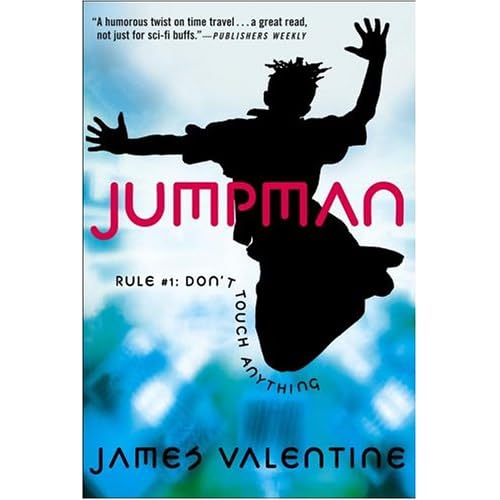
Arty -- Don't Touch Anything by James Valentine


All Jules wanted to do was ask Gen out. He had battled his brain (literally) for who-knows-how-long about how to go about it and whether to even do it.

And just when he's finally about to pop the question, some kid with technicolor hair and a talking Coat materializes in Gen's room. Not a situation conducive to asking a pretty girl out on a date.

As it turns out, Theo is from waay in the future, which explains the whacky hair and ad-spewing Coat. In his time, he won a contest to be the first kid to use the newest JumpMan - the device that allows everyone to go back in time. But there's something wrong with this new (new?) JumpMan - and that's why Theo's in Jules's time. That's also why he can't get back to the future.

Well, what are Jules and Gen supposed to do? Let Theo try to make it back to the future without helping? Of course not.

Already, it's not such an original plot. (Unless there's a dearth of time travel novels in Australia, which is where the author is from - something very helpful in decoding the book's lingo.) The writing is decent, and there are some seriously funny parts - particularly Jules's squabbles with his own brain.

Jules, in fact, is pretty much the only likable person around. He's the classic not-too-popular, not-too-handsome kind of stock character that you really can't help loving because no one else does. Gen is also a stock character - the pretty, popular, girly-magazine-reading girl with (theme music) girl powah. Why Jules is so in love with her, I haven't a clue, because he really is smarter than that.

I'm pretty sure we're supposed to like Theo, the off-the-wall, funny, careless guy from the future who has crazy hair and an awesome Coat. But I didn't. Why exactly did he hate Jules's guts right from the start? Why does he think Gen is awesome but not Jules? Why is Gen so enthralled with Theo? (Oh, right - because he's funny and looks cool. That's it.) He just came off as some pompous jerk, bragging about how much better the future is than the 21st century. (And yet there's no sarcasm or scorn for the Neanderthals they go back in time to see... how does this work, exactly?)

For a long time, zombies have been a dramatic symbol of modern social structure and politics (or so they say). Werewolves and vampires are dramatic symbols of human failings and morality. Time travel, I think, has become the dramatic symbol for eco-friendly, go-green messages. I find nothing inherently wrong in this... except that Don't Touch Anything handles its own message less than gracefully.

It's basically 'You bad, 21st century humans you, destroying the earth. Be ashamed.' There's one part where Theo is explaining how the world was used up (an inevitable plot twist). In essence, he tells Jules and Gen, 'Your time was the biggest mistake in the world.' Jules and Gen apologize - literally. 'We're sorry.' Is it just me, or is this not really fair? And don't get me started on the whales - no way do I want whales to go extinct, but can Valentine not come up with a more original way of expressing the horrors of extinction?

I mentioned Neanderthals a little before now. I found it interesting that Valentine never goes back in time to any documented period of history. Jousts and beheadings are mentioned, but the only trips that Jules, Gen, and Theo take (besides a very quick materialization in ancient Egypt) are to the times before mankind (supposedly). It's all oooh-pre-Big-Bang! and look-the-first-animal. I don't believe evolution, so maybe it's just me, but it made the book seem more like a textbook than an interesting story.

In retrospect, I realize that I made Don't Touch Anything sound like a horrible book. It's not. It was interesting, even thought-provoking a time or two (though I'm not sure any halfway-decent time travel book isn't). But I think Valentine could have done better, put a little more effort and a little less textbook material into it. As it was, it barely felt like he tried. For more interesting, well-pulled-off time travel, I'd suggest Linda Buckley-Archer's Gideon trilogy or The Dreamhouse Kings series by Robert Liparulo.

Tuesday, April 12, 2011

Arty -- The Fall of Lucifer by Wendy Alec

Yes, I know. Another Tuesday review. I'm sorry - the life of an American teenager is pretty busy.

Anyway. The Fall of Lucifer. Just by its title I'm sure most people can guess what it's about - the fall of the angel Lucifer, the son of the morning, from Heaven.

His tale of woe is told mostly from the perspectives of his two archangel brothers, Michael and Gabriel. In the beginning, the three are inseparable - reflecting, as they imagine, the Triune God, three brothers in one. Lucifer, the eldest, second only to Yehovah Himself; Michael, the warrior angel; and Gabriel, the little brother who also has the gift of revelation. Lucifer is, perhaps, the most devoted of Yehovah's angels.

Then, inexplicably, Yehovah creates mankind.

This drives a serious wedge between Lucifer and Yehovah - at least in Lucifer's mind. Driven mad with jealousy over mankind's seeming theft of Yehovah's affections, Lucifer... well, falls.

I really, really wanted to like this book. Angels, Three-Musketeer-style brotherhood, and the most ancient of all betrayals - how could it go wrong?

Well...

The idea is wonderful. All the way through, the plot and characters had such potential that it was almost painful to see how it was carried out. Alec desperately needs an editor... and perhaps a refresher course in how dialogue is written. And description. And character, for crying out loud. Maybe even a bit of basic Christian theology, though the unorthodox views can easily be taken for her attempts at creativity.

It hurt my inner editor when I saw the three archangels interacting - so much she could have done! But for the most part, their conversation reads like Hamlet's inept actors - sawing the air, tearing a passion to rags, to very tatters. And the old writers' rule of Show Don't Tell? Out. the. window.

I was never really sure about the setting. Most of the time, it's in Heaven - which, of course, is beautiful beyond compare. But Alec never really gives a concrete description - it's all flowery, vague ideas of rushing water and gem-covered castles and... complex laboratories. Yes, laboratories. Heaven has laboratories. And mad-scientist angels. Who knew, right? (Yes, I found it a bit disconcerting that the angels created mankind from Yehovah's DNA. God has DNA? Oh well.)

If Ms. Alec is reading this, I hope she isn't offended, because I really wanted to like this book. There were some truly striking scenes - and when it came to Lucifer's agony over his paranoia of mankind, I actually felt sorry for the guy (though whether it's appropriate to feel sorry for Satan, I'll leave to more knowledgeable minds than mine).

So, if you're an angel enthusiastic or if you like a light Christian fic that doesn't take much to follow, I'd say pick this one up. Otherwise, find something more engaging (and well-written) to read. (My alternative would be the Dragons in our Midst series by Bryan Davis or The Prophecy by Dawn Miller.)

Friday, April 1, 2011

Persy -- Going Bovine by Libba Bray

Yep, that's right. I'm posting BEFORE the end of the weekend! In fact, some would argue if it's even Saturday yet. I deserve a reward. Unfortunately, we're all out of sugar, and while it would be amusing to go ask a neighbor for three tablespoons of sugar, it'd also be weird since I barely even know my neighbors. And no, none of this is a at all relevant to...

Going Bovine by Libba Bray. Most people know Libba Bray from her young adult historical fantasy/romance series Gemma Doyle, but in "Bovine", she tackles indie/scifi, which isn't something you hear every day.

Cameron is just a teenager. He doesn't really do much, and his only main interest is in the old music of the Great Tremolo, a Portuguese singer who has vocal cords like no other. It cracks Cameron up.

But that all changes when Cameron is suddenly infected with mad cow disease. Sorry, Cameron, but you're dying. Not much we can do about it. That is, according to the human doctors. But then a punk angel, Dulcie, shows up at Cameron's bedside and tells him that he must go on a journey to save not only himself, but the world. And he's got to take Gonzo, the paranoid dwarf, along with him.

Easier said than done.

Despite his doubts, Cameron pretty much says, "What the heck," and he and Gonzo break out of the hospital and go on a road trip searching for the mysterious Dr. X. They have many adventures along the way, including picking up Balder, a Norse god who has been cursed into the shape of a yard gnome.

To summarize: Cameron (mad cow diseased teen), Gonzo (paranoid dwarf with a lot of hair), and Balder (Norse god yard gnome) embark on a quest to save the world from a parallel universe with nothing but the cryptic hints of Dulcie (punk angel who likes sugar). Aaaawesome.

Needless to say, I really enjoyed this book. It's a surreal ride, with a surprisingly good plot (y'know, instead of just having a bunch of dudes in car riding around, there's a memorable purpose) and fun characters. Speaking of which, the way the characters grow, mature, and bond is very well done.

I really don't want to give away the ending, so I'll try not to say any more. But Libba Bray does an amazing job of 'life flashing before your eyes' kind of thing, even if she didn't mean to. The absolute only thing I would change about this novel was the little epilogue. It seems unnecessary, when the last chapter was an excellent ending. Also, there's that little thing with Gonzo, but that's just a personal preference of mine.

In my opinion, Libba Bray does stand-alone novels even better than she does series', so I'm looking forward to her next novel, Beauty Queens, which comes out in May. Also, if you enjoy Going Bovine, I'd reccommend seeing the movie 'Interstate 60'.

--Persy

Note: This book does contain adult content such as strong language and sexual content.